Westport Police Department Announces Upcoming Promotions


On Thursday, June 12, 2014 the Westport Police Department will promote five officers. The ceremony will take place at 3:00 P.M. in the Westport Police Department classroom. These promotions come after several months of competitive testing and will fill vacancies in rank created through retirements.


To be promoted to the rank of Lieutenant:

    Sergeant Ryan Paulsson was hired in December 2000 and was promoted to the rank of Sergeant in 2012. Sergeant Paulsson was the department’s Bloodhound handler for 10 years and has supervised the K9 Unit since 2010. Officer Paulsson serves as a tactical officer with the Southwest Regional Emergency Response Team, member of the Westport Police/Fire Dive-Rescue Team and the Marine Division. He is a certified Law Enforcement instructor in numerous disciplines. Officer Paulsson is a trustee with the Westport Police Benevolent Association and is chairman of the department’s Awards Committee. Officer Paulsson has received numerous department awards, including a Meritorious Police Duty Award for locating an endangered missing person in 2008.

Officer Paulsson holds a Bachelors degree in Justice and Law Administration from Western Connecticut State University. He resides in Milford, CT with his wife Jacqie and daughter Emmalyn.

    Sergeant Jillian Cabana was hired in May 2006. She was promoted to the rank of Detective in August 2009 and to the rank of Sergeant in January 2013. Sergeant Cabana is the Domestic Violence Liaison for the Police Department. She has received several department awards, including the Meritorious Police Duty Award.

Sergeant Cabana is a graduate of the University of New Haven with a Bachelors degree in Criminal Justice. She is currently working towards her Masters degree in Justice Studies with a concentration in Public Administration through Southern New Hampshire University.

Sergeant Cabana is married and the mother of a 1-year-old daughter.


To be promoted to the rank of Sergeant:

Officer David Wolf was hired in August 2001. Officer Wolf has served as a Field Training Officer and DARE officer. He is currently the coordinator of the Department’s Crisis Intervention Team, a Crisis Negotiator with the Southwest Regional Emergency Response Team, and member of the Department’s bicycle squad. Officer Wolf is a certified Law Enforcement instructor in search and seizure, civil liability and eyewitness identification.

Officer Wolf received his Bachelor of Arts from Franklin and Marshall College, his Masters in Health Care Administration from Western Connecticut State University and is entering final year of the Juris Doctor program at the University of Connecticut School Of Law.

Officer Wolf lives in Oxford with his wife and four children.

Officer Matthew Gouveia was hired in January 2008. Officer Gouveia is a recipient of the Chief Samuel J. Luciano Award for academic excellence, awarded by the Connecticut Chiefs of Police Association (and named for the former Westport Chief of Police) as well as a Chief’s Commendation from the Westport Police Department.

Officer Gouveia received his Bachelor of Science degree in Criminal Justice from Roger Williams University and his Juris Doctor from the Roger Williams University School of Law. Officer Gouveia is a member of the bar in Connecticut, Massachusetts, and Rhode Island.

Officer Gouveia is a native of Massachusetts, where most of his family still resides.


To be promoted to the rank of Detective:

Officer Marc Heinmiller was hired in October 2003. Officer Heinmiller was a K9 handler for 5 years until the retirement of his dog, Lola, in 2012. He has also served as a Field Training Officer and a member of the Marine Division and Honor Guard. Officer Heinmiller has received numerous departmental awards, including a Lifesaving Award.

Officer Heinmiller holds a Bachelor of Science degree from Western Connecticut State University.

GOV. MALLOY: CONNECTICUT MAKING SIGNIFICANT PROGRESS IN ADDRESSING GLOBAL WARMING


Report from DEEP Shows Decline in Carbon Emissions


(HARTFORD, CT) – Governor Dannel P. Malloy said that Connecticut is making significant progress in reducing statewide emissions of harmful greenhouse gases (GHGs) to meet requirements set in state law, citing a report issued today by the Department of Energy and Environmental Protection (DEEP) that details the state’s progress toward meeting the statutory mandate to reduce greenhouse gas emissions to 10% below 1990 levels by 2020, and 80% below 2001 levels by 2050.


The report, required under Connecticut’s 2008 Global Warming Solutions Act (Public Act 08-98), demonstrates that Connecticut is clearly on a trajectory to meet the 2020 mandate much sooner than that date and is putting programs in place to meet the 2050 mandate.


“Make no mistake about it, Connecticut is doing its part to slow global warming.  In fact, we are a national leader in efforts to reduce the amount of carbon emissions being put into the atmosphere.  Connecticut rolled our emissions back to 1990 levels two years sooner than anticipated,” Governor Malloy said, referring to a goal that was adopted by several northeastern states and eastern Canadian provinces and was to be achieved by 2010.  “The recent National Climate Assessment — documenting heat waves, droughts, deluges, and disease as climate impacts that are already occurring — underscores just how crucial this effort is.”


Data in the report demonstrates that total emissions of carbon dioxide and other climate pollutants from power plants, automobile tailpipes, household boilers, waste-to-energy facilities and other sources peaked in 2004 and then declined by a total of 17 percent through 2010, the most recent year for which full data are available.  As of 2010, Connecticut achieved more than half the reductions required by 2020 under the Global Warming Solutions Act, having reduced its emissions to 5.4% below 1990 levels.


The report shows that the biggest reduction was achieved in the electric power sector, where emissions fell 31 percent since 1990 and 22 percent since 2005.  The reductions in the power sector put Connecticut on track towards compliance with the carbon pollution standards for existing power plants released yesterday by the U.S. Environmental Protection Agency (EPA).


Other substantial emissions reductions documented in the report include:


  • Residential sector, where emissions fell 5 percent since 1990 and 24 percent since 2004.


  • Transportation sector, where emissions are dominated by tailpipe emissions from personal vehicles, Connecticut has seen an impressive 17% decrease in emissions from 2004.  Additional work is needed, however, to meet the state’s 2020 and 2050 emission reduction mandates.


Connecticut is working diligently to reduce transportation emissions by enacting stringent tailpipe emissions limits for cars and trucks sold in the state, building “range confidence” in order to facilitate adoption of electric and fuel cell vehicles that don’t have any tailpipe emissions, increasing mass transit opportunities, and supporting transit oriented urban/suburban planning.


“Statewide emissions of climate pollutants are clearly responding to the aggressive policies and programs Connecticut has put in place,” DEEP Commissioner Robert Klee said.  “Our progress is the direct result of an array of initiatives including  capping carbon emissions from the power sector through our participation in the Regional Greenhouse Gas Initiative (RGGI); expanding popular and cost-effective energy savings programs to help residents and businesses reduce their energy bills;  generating more electricity from cleaner, cheaper natural gas rather than coal or oil; and increasing by ten-fold the amount of electricity we generate in-state from renewable sources.”


“All of these actions were recommended in the state’s Climate Change Action Plan, adopted in 2005, and were key features of Governor Malloy’s Comprehensive Energy Strategy, adopted in 2013,” Klee added.


“Connecticut’s early success in fighting climate change demonstrates our commitment to protecting the environment, preserving a viable future for our children, and doing so in a manner that improves air quality, bolsters the economy, creates jobs, and saves money for families and businesses,” Klee said.  “Based on the success we have achieved, it is clear that there is no conflict between the environment and the economy when it comes to reducing carbon emissions.”


Complementing its efforts to mitigate global warming by reducing emissions of GHGs, Connecticut has also launched major efforts to address the issue of climate adaptation – to deal with changes in climate that will result from the level of emissions already in the atmosphere.  These include:


  • Established a ground-breaking microgrid program designed to help keep critical infrastructure, like hospitals, police stations, pharmacies and gas stations; operating when the there’s an electrical outage.


  • Launched the Connecticut Institute for Community Resilience and Climate Adaptation, a partnership between the University of Connecticut, DEEP, and the National Oceanic and Atmospheric Administration, to develop strategies to enhance the resilience of coastal and riverine communities while protecting natural ecosystems from climate change.


  • Approved legislation requiring more planning and preparation by the electric utility companies – and holds them more accountable for their performance during and after storms.


  • Created a Connecticut Shoreline Resiliency Fund, a low-interest loan program to help residents elevate their homes and businesses and flood-proof their facilities if they are subject to coastal flooding.


“Connecticut is tackling climate change holistically: working to bring climate change under control and to prepare for and minimize its impacts,” Klee said.  “These efforts will assure that Connecticut remains a great place to live, work, and play.”


Data recently released from the U.S. Energy Information Administration shows that Connecticut was one of the top 3 lowest energy-related C02 emitting states in the U.S. per unit of economic output.


The “Taking Action on Climate Change: 2014 Progress Report” is available online at www.ct.gov/deep/climateprogress2014


Fairfield Police Investigate 2 Possible Abductions of Women

©2014 DoingItLocal.com NOT for broadcast, you must contact us first for conditions.
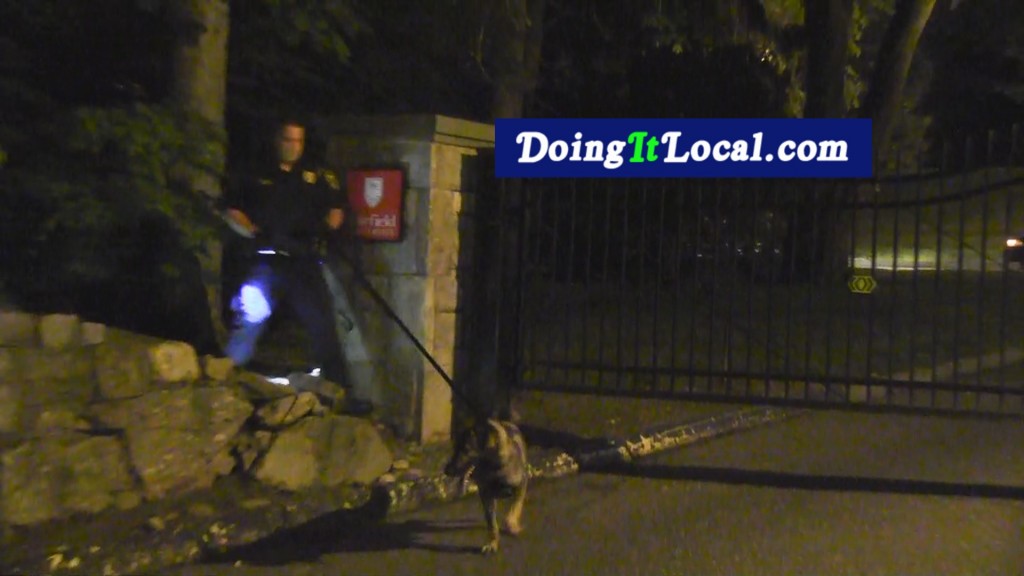
#Fairfield CT–Fairfield Police investigated two reported abductions of women withing an hour between calls. The first call was around 8:30pm when a mother called police that her daughter went out on a jog and was missing. A short time later the mom called police that another family member received a call from the victim that she was confused and did not know where she was. She then reported that her assailant made her cut her face, not a stabbing as reported by other media. The victim was treated by AMR while Fairfield’s K-9 Ruger and Officer Kevin Wells tracked the suspect in the wooded area behind Fairfield University at College Park Road, near the soccer/lacrosse fields of the University. They were looking for a white male, dressed in all black with a mask. The track ended about 45 minutes later when police received another call for another abduction report, this time in the Chip’s Parking Lot at 525 Tunxis Hill Cut Off. A Hispanic Male grabbed a black woman with a bloody nose and threw her into the passenger seat of a dark colored Toyota with a baby and baby sear in the backseat , and fled down Tunxis Hill Cut Off towards Kohl’s. Both abductions are under investigation. All audio from police was edited and not in real time. ©2014 DoingItLocal.com NOT for broadcast.

Fairfield Police Investigating Two Abductions of Women

#Fairfield CT–Fairfield Police Department are investigating two possible abductions of women. The first was at Fairfield University where a woman was stabbed by a white male wearing all black and a mask around 8:30pm(photo).  She escaped.   An hour later police responded to a caller that witnessed a black woman with a bloody nose be forced into a car by a Hispanic male in the Chip’s parking lot on Tunxis Hill.  I’ll have exclusive video from Fairfield University later.

Exit mobile version