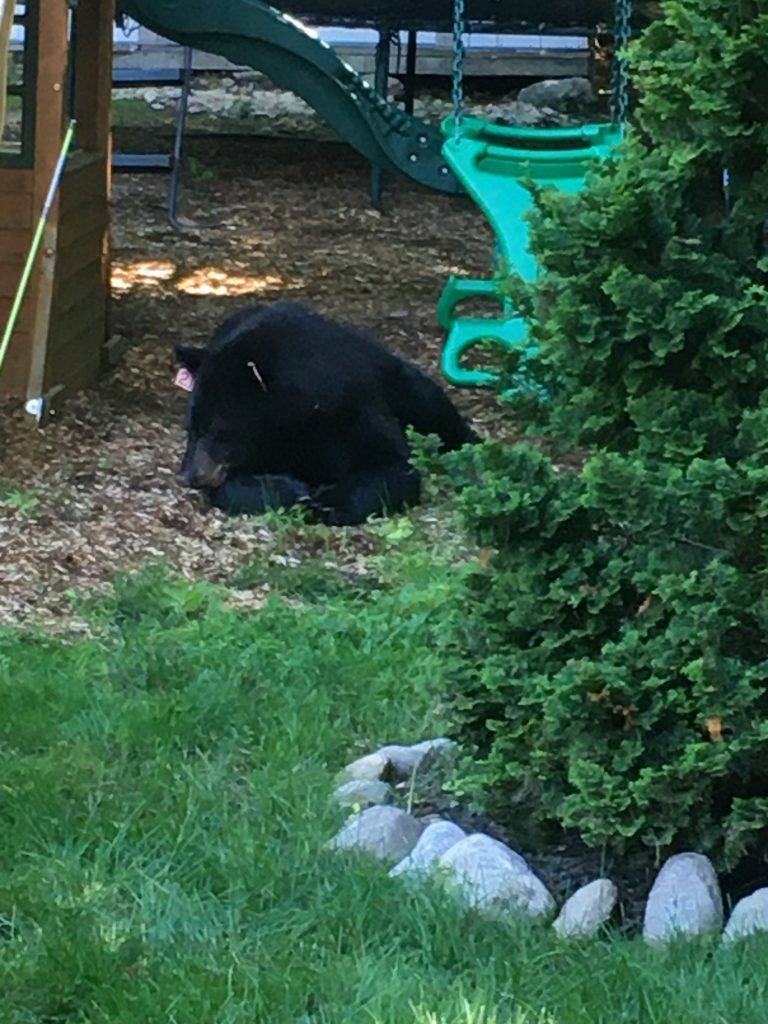
Bear 211 Visits Pre-School

2021-06-24@12:40pm–#Fairfield CT–#bear211– The children playing on the playground at St. Timothy Pre-School on Congress Street were quickly brought inside after Bear 211 made a visit. The bear was no longer on the scene when animal control and I arrived after our 15 minute ride to the pre-school. Bear 211 has it’s own Facebook page at: https://www.facebook.com/groups/486506749295341 He gets around and fast!

PURA DECISION TO ACCEPT AMENDED SETTLEMENT AGREEMENT WITH UI

Hartford, CT) — Attorney General William Tong released the following statement regarding a decision by the Public Utilities Regulatory Authority to accept an amended settlement agreement with United Illuminating and state entities to provide millions of dollars in immediate savings and long-term stability for UI customers. In conjunction with a planned start of lower summer standard service rates, UI customers would see a 5.2 percent total bill decrease starting on July 1. 

“This is a big win for Connecticut families,” Attorney General Tong said. “This amended settlement, with the planned start of lower summer standard service rates, will save UI customers 5.2 percent on their bills starting next week. I commend PURA for approving this amended settlement and working with us to bring rate relief and stability to UI customers. Energy costs far too much in our state and this agreement brings a much-needed break to families who need it.”

See here for a prior video explainer from Attorney General Tong on fluctuations between summer and winter electricity rates.

In March, Attorney General Tong and Governor Lamont brokered an agreement with UI, the Department of Energy and Environmental Protection, the Office of Consumer Counsel and PURA’s Office of Education, Outreach and Enforcement to decrease and stabilize electric rates into 2023. The agreement fully offsets what would have been a five to eight percent increase in bills on May 1 due to federally-mandated transmission charges and the costs of the Millstone power purchase agreement. The settlement includes a $5 million voluntary contribution from UI’s own coffers, and also accelerates the return of $41.55 million of accumulated savings from federal tax cuts ahead of what would have otherwise been required. In addition, UI agreed to not change base distribution rates until at least May 2023—an agreement that will save ratepayers a projected $20 million in addition to  the $46.5 million relief from the accumulated tax savings and UI’s voluntary contribution.

PURA initially rejected the settlement, and instead proposed an alternative plan to amortize the accumulated charges over a 68-month period. At the urging of Attorney General Tong and other settling parties, PURA reconsidered its draft decision, agreeing to revisit the merits of the settlement and allowing settling parties to continue to negotiate.

Attorney General Tong, UI and the settling parties agreed to an amended settlement that will immediately decrease base distribution rates an additional 0.2 percent effective July 1 to reflect reductions in the federal corporate tax rate, a key priority for PURA in its draft decision.

Visit BMW of Bridgeport at: https://www.bmwofbridgeport.com/

Westport News: Bear In A Sunroom(Westport, CT) On June 23, 2021, there were multiple sightings of the same bear in the northern part of town. At approximately 2:30 p.m., Westport Police officers as well as the animal control officer responded to a home on Highland Road on a report of a bear in the yard. After it departed that location, it went to a second home on the same road and reportedly put his paw on an individual who was outside gardening. However, the bear did not act aggressively towards this person nor was the man injured. The animal finally ended up on Warnock Drive where it entered an unoccupied sun porch. By the time the animal control officer arrived the bear had left the sunroom and was sitting in the yard. The Department of Energy and Environmental Protection responded and assisted with monitoring the bear’s activities. It was last seen heading west towards Weston. Peter Reid, Westport’s Assistant Animal Control Officer, stressed that the bear was acting normally and not behaving in an aggressive manner. However, ACO Reid cautioned against getting too close to the bear to photograph or record it as you would not want to make it feel cornered or trapped. At this time, there is no indication that the bear poses a threat to the community, but common- sense precautions should be taken. As stated in an earlier release, it is a good idea to take down bird feeders for the summer as bears are attracted to them. Additionally, grills and outdoor dining tables should be cleaned with a diluted bleach solution after each use as the smell of the food also attracts bears. Bear sightings can be reported to Westport Animal Control at (203) 341-5076 or reported to DEEP via this link: https://survey123.arcgis.com/share/187a8a495d4e4ca497261d163d6fffc9


2021-06-23@3:02pm–#Westport CT– Report of a bear in a sunroom at Warnock Drive.

Good day for that and Micalizzi’s!

GOVERNOR LAMONT SIGNS BILL LEGALIZING AND SAFELY REGULATING ADULT-USE CANNABIS

(HARTFORD, CT) – Governor Ned Lamont this afternoon signed into law legislation that legalizes and safely regulates the adult-use of cannabis in Connecticut. The legislation contains comprehensive reforms that address many areas, including equity, criminal justice, public health, and public safety.

“For decades, the war on cannabis caused injustices and created disparities while doing little to protect public health and safety,” Governor Lamont said. “The law that I signed today begins to right some of those wrongs by creating a comprehensive framework for a regulated market that prioritizes public health, public safety, criminal justice, and equity. It will help eliminate the dangerous, unregulated market and support a new and equitable sector of our economy that will create jobs. The states surrounding us already, or soon will, have legal adult-use markets. By allowing adults to possess cannabis, regulating its sale and content, training police officers in the latest techniques of detecting and preventing impaired driving, and expunging the criminal records of people with certain cannabis crimes, we’re not only effectively modernizing our laws and addressing inequities, we’re keeping Connecticut economically competitive. This legislation directs significant new funding to prevention and recovery services, which will be used to help prevent cannabis use by minors and to promote safe, healthy use of cannabis by those of legal age.

“This measure is comprehensive, protects our children and the most vulnerable in our communities, and will be viewed as a national model for regulating adult-use cannabis. By signing this into law today, we are helping our state move beyond this terrible period of incarceration and injustice.”

The legislation Governor Lamont signed today is Senate Bill 1201. A proposal to legalize adult-use cannabis was initially put forward by Governor Lamont to the General Assembly earlier this year as Senate Bill 888. He also proposed similar legislation in February 2020 as Senate Bill 16.

Key components of the new law include:

  • Possession: Possession of cannabis among adults age 21 and over will be legal in Connecticut beginning July 1, 2021. Adults cannot have more than 1.5 ounces of cannabis on their person, and no more than 5 ounces in their homes or locked in their car truck or glove box.
  • Retail sales: Retail sales of cannabis aim to begin in Connecticut by the end of 2022. The sale, manufacture, and cultivation of cannabis (aside from home grow) requires a license from the state. Products that contain delta-8-THC, delta-9-THC, or delta-10-THC are considered cannabis and may only be sold by licensed retailers. Individuals who are not licensed by the state may gift cannabis to others but may not sell it. Individuals may not gift cannabis to another individual who has “paid” or “donated” for another product.
  • Homegrown: Patients who are participating in Connecticut’s medical marijuana program will be permitted to cultivate up to six cannabis plants (three mature, three immature) indoors within their homes beginning October 1, 2021. All adults age 21 and over will be permitted to grow a similar number of plants indoors within their homes beginning July 1, 2023. The law includes requirements to keep the plants secure from anyone else. Home grow of up to six cannabis plants is defelonized beginning July 1, 2021, and instead will result in infractions.
  • Erases prior convictions: Certain cannabis-related convictions that occurred between January 1, 2000 and October 1, 2015 will be automatically erased. Those seeking to erase cannabis-related convictions outside of that period will require petitioning.
  • Equity and investments: To start the necessary work of repairing the damage caused by decades of failed cannabis criminalization policies, the law implements equitable marketplace requirements under which at least half of all initial licenses are reserved for social equity applicants, targeting those communities that have been most negatively impacted by the so-called war on drugs. The Social Equity Council, which is created by this legislation, will launch a programs and supports for social equity applicants in the cannabis market.
  • Tax structure: The law enacts a tax rate structure on the retail sale of cannabis that includes a new source of revenue for municipalities. This includes (1) a 3% municipal sales tax, which will be directed to the town or city where the retail sale occurred; (2) the 6.35% state sales tax; and (3) a tax based on the THC content of the product, which will be 2.75 cents per milligram of THC for cannabis edibles; 0.625 cents per milligram of THC for cannabis flower; and 0.9 cents per milligram of THC for all other product types. This means that Connecticut generally will have about a 4% lower tax rate than New York and about the same as Massachusetts.
  • Revenue to support economic opportunities in targeted communities: Portions of the revenue obtained from retail sales of cannabis will be directed to communities that have been most negatively impacted by the war on drugs through the creation of the Social Equity and Innovation Fund. Funding from this account will be appropriated for use by the Social Equity Council to provide business capital, technical assistance for business start-ups and operations, workforce education, and community investments. These investments will not be limited to the cannabis market.
  • Revenue to support substance misuse prevention and recovery services: Portions of the revenue obtained from retail sales of cannabis will be directed to support substance misuse prevention, treatment, and recovery services through the creation of the Prevention and Recovery Services Fund. Connecticut’s health agencies, including the Department of Public Health, Department of Mental Health and Addiction Services, and Department of Children and Families will launch new programs and initiatives regarding prevention, treatment, and recovery in regard to cannabis.
  • Preventing underage use: This legislation adapts the state’s strong framework regarding preventing access to alcohol by minors in the context of cannabis. For example, it will be a Class A misdemeanor to sell or provide cannabis to a person under 21 years old. In addition, an individual allowing someone under 21 years old to loiter at a cannabis store will receive a $1,000 fine on the first offense with subsequent offenses as a Class B misdemeanor. It will be a Class D misdemeanor for a person under the age of 21 to lie about their age or use a fake ID in an attempt to buy cannabis. Delivery services will be required to use online ID and age verification.
  • Enforcement of safe driving: This law significantly strengthens Connecticut’s impaired driving statutes by requiring police to be trained in Advanced Roadside Impaired Driving Enforcement (ARIDE) and allows for Drug Recognition Expert (DRE) evaluations to result in license suspensions. This means that drivers who are impaired on any substance, whether cannabis or otherwise, will be more quickly taken off the roads.
  • Advertising: This law implements strong standards for advertising that exceed those for the tobacco and alcohol industries. All cannabis-related advertising will be banned on television, radio, internet, print, and billboards unless the advertiser has reliable evidence that more than 90% of the audience reached by the advertising is at least 21 years of age or older. Advertising of cannabis is restricted within 500 feet of a school. The advertising restrictions apply to all cannabis advertising, whether or not the advertiser is a state licensee.
  • Safe products: This legislation imposes strong requirements for product safety. Products will have to be lab tested and will have strict packaging and labeling standards. Edible cannabis products are limited to 5 milligrams of THC per serving, and most other products are subject to a potency cap. Products will be in child-safe packaging, and product types that appeal to children are banned.
  • Municipalities and zoning: Local officials will play an important role in the implementation of cannabis legalization. For example, local officials can control the number and locations of cannabis retailers through zoning. Municipalities can also determine where smoked or vaped cannabis can be consumed (e.g. in city parks or beaches, or on sidewalks or streets).
  • Employment: This legislation allows employers to continue to enforce drug-free workplaces, and respects the need for employers to maintain workplace safety and to remain in compliance with federal laws and contracts. As such, employers in certain industries, such as manufacturing and healthcare, are considered “exempt” from the employment provisions of this law. The law allows employers to take adverse actions against employees who are impaired at work. The law says that nonexempt employers may not prohibit the off-work use of cannabis or take adverse action against an employee or a potential employee for a positive THC test unless such employer has adopted employment policies stipulating as such. Generally, an employer may not take adverse action against an employee or potential employee for use of cannabis prior to applying for or working at such employer.
  • Medical marijuana program: The law protects Connecticut’s nation-leading medical marijuana program in many ways. For example, producers and dispensaries that currently operate in the medical marijuana program may expand or convert their licenses for adult-use cannabis, but they must prioritize serving the medical program. Medical marijuana users will soon be able to purchase medical marijuana from any dispensary rather than simply the one to which they are assigned.
  • State parks and beaches: Cannabis use is prohibited in state parks, state beaches, and on state waters.

This press release was made possible by:

LANCE EDWARDS APPOINTED ACTING FIRE CHIEF IN THE CITY OF BRIDGEPORT

Bridgeport made the appointment of Lance Edwards to be Acting Fire Chief for the Bridgeport Fire Department.

“Acting Fire Chief Edwards has served our community on various levels in the Bridgeport Fire Department,” stated Mayor Ganim.  “We look forward to his leadership and contributions in this new role, while maintaining the safety of Bridgeport residents.”

Acting Fire Chief Lance Edwards has over 30 years of experience in firefighting and fire management. He started in 1988 in the town of Stratford as a firefighter, eventually moving up to the rank of Lieutenant and then Assistant Chief.  He also has extensive background in labor-management mediation and negotiations. 

Exit mobile version