GOVERNOR LAMONT REMINDS CONNECTICUT RESIDENTS: LOW-TO-MODERATE INCOME INDIVIDUALS AND FAMILIES ARE ELIGIBLE FOR SIGNIFICANT BOOST IN INCOME TAX CREDITS THIS YEAR

Newly Enacted Rate Change in the Earned Income Tax Credit Comes in Addition to the Recent Cut in Income Tax Rates for Middle-Income Workers (HARTFORD, CT) – Governor Ned Lamont today is reminding Connecticut residents that thousands of low-to-moderate income individuals and families in the state are eligible to receive a significant boost in tax credits when they file their personal income tax returns this year due to a newly enacted rate change in the Connecticut Earned Income Tax Credit (EITC), which has increased from the most recent rate of 30.5% for the 2022 income year to the new rate of 40% for the 2023 income year.

The rate change – which was enacted as a result of the state budget bill that the legislature approved and Governor Lamont signed into law last year and which also includes several other significant tax relief measures – means that lower-income filers will receive several hundred dollars in additional tax credits this year above what they received the prior year, depending on their income and number of dependents. Typically, more than 95% of filers who receive this credit have families with children. “Increasing the rate of the Connecticut Earned Income Tax Credit is one of the most impactful provisions in the recently enacted state budget because it will provide direct relief to low-to-moderate income workers who are providing for their families,” Governor Lamont said. “Numerous studies have shown that this tax credit is one of the best anti-poverty tools we can use because it encourages work, boosts economic stability, and uplifts generations to come. Ultimately, these tax credits improve entire communities because these dollars are being invested right back into our local economy through groceries, transportation, clothing, rent, utilities, and other necessary expenses. I want to make sure Connecticut’s working families know about this tax credit and claim it.” “The Department of Revenue Services is proud to administer the Earned Income Tax Credit, as it provides direct relief to working families across Connecticut,” Connecticut Department of Revenue Services Commissioner Mark Boughton said. “Our dedicated DRS staff are happy to help all taxpayers who qualify for this credit to claim it on their tax returns. Additionally, individuals who qualify may utilize assistance from the Volunteer Income Tax Assistance Program.” The Connecticut EITC is based on the amount of the federal EITC. It is available to those earning less than: $56,838 ($63,698 married filing jointly) with 3 or more qualifying children $52,918 ($59,478 married filing jointly) with 2 qualifying children $46,560 ($53,120 married filing jointly) with 1 qualifying child $17,640 ($24,210 married filing jointly) with no qualifying children It is estimated that approximately 211,000 households in Connecticut are eligible. The Connecticut EITC was created in 2011 and has had varying rates over the last decade, including 30% in 2012, 25% in 2013, 27.5% from 2014 to 2016, 23% from 2017 to 2020, and 30.5% in 2021 and 2022. This new 40% rate makes Connecticut among the top five states in the nation with the largest EITC rates. EITC rate increase comes in addition to the income tax cut for middle-income households that took effect January 1, 2024 In addition to the rate change in the Connecticut EITC, the state budget bill that Governor Lamont signed last year includes cuts to the state’s income tax rates that are targeted toward providing relief to middle-income households earning less than $150,000 for single filers and $300,000 for joint filers. Those cuts, which went into effect on January 1, 2024, reduced the two lowest rates of the state’s progressive tax structure by: Decreasing the rate on the first $10,000 earned by single filers and the first $20,000 by joint filers from 3% to 2%; and Decreasing the rate on the next $40,000 earned by single filers and the next $80,000 by joint filers from 5% to 4.5%. This is the first time that income tax rates have been cut in Connecticut since the mid-1990s. It is also the single largest income tax cut enacted in state history. The income tax cut is estimated to benefit more than one million tax filers.

New Album Drop–What Is The Meaning Behind It?

Joe Grit$’s new album More Gangsta Than Political has been released. Before he headed out on his tour he gave us an insight on the meanings behind the songs. Oh, Mayor Joe Ganim also makes an appearance in the album! Hear the album here: https://songwhip.com/joe-grit/the-hypocritical-2-more-gangsta-than-political-album latest album link

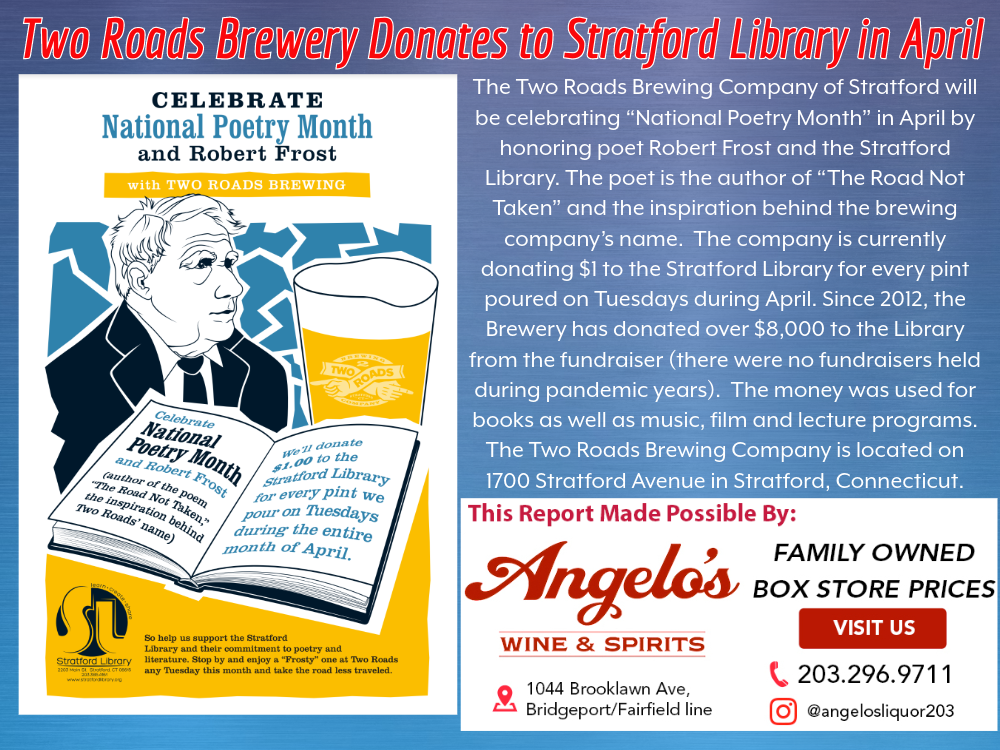
Two Roads Brewery Donates to Stratford Library in April

The Two Roads Brewing Company of Stratford will be celebrating “National Poetry Month” in April by honoring poet Robert Frost and the Stratford Library. The poet is the author of “The Road Not Taken” and the inspiration behind the brewing company’s name. The company is currently donating $1 to the Stratford Library for every pint poured on Tuesdays during April. Since 2012, the Brewery has donated over $8,000 to the Library from the fundraiser (there were no fundraisers held during pandemic years). The money was used for books as well as music, film and lecture programs. The Two Roads Brewing Company is located on 1700 Stratford Avenue in Stratford, Connecticut.

Neighborhood Assistance Act (NAA) Tax Credit Program is Currently Accepting Applications for Municipal and Tax-Exempt Organizations

Westport, CT –Director of Human Services Elaine Daignault has announced that the Town is now accepting applications for the 2024 Neighborhood Assistance Act (NAA) Tax Credit Program sponsored by the CT Dept. of Revenue Services (DRS). The deadline for submissions to the Town’s Human Services Department is Friday, May 17, 2024. The NAA program is designed to fund municipal and tax-exempt organizations by providing a corporation business tax credit for businesses that contribute cash to these entities.

The NAA program allows businesses to claim a State tax credit for cash contributions to qualifying community programs conducted by tax-exempt or municipal agencies. The community programs that qualify for the NAA tax credit include but are not necessarily limited to energy conservation, employment and training, childcare services, programs serving low-income persons, open space acquisition, crime prevention programs, and affordable housing development. The minimum contribution on which a tax credit may be granted is $25,000, and the maximum contribution that any nonprofit or municipal entity can receive under this program is $150,000. No Town funds are involved in this program.

Each municipal agency or tax-exempt organization wishing to participate in the NAA Program must complete the program proposal application on the CT DRS website. This form must be submitted to the municipality for approval by its governing body. All locally approved programs must be submitted to the DRS before July 1, 2024.

For further information about the Neighborhood Assistance Act Program, please visit the DRS website at http://www.ct.gov/DRS. (Search for 2024 Neighborhood Assistance Act program application). Agencies wishing to participate should submit applications to Elaine Daignault, Director, Westport Department of Human Services, 110 Myrtle Ave., Westport, CT 06880 by Friday, May 17, 2024. The list of participating agencies will be submitted to the Representative Town Meeting for approval at its meeting on Tuesday, June 4, 2024.

The Fairfield Police Department and the CTDOT Team Upto Kick off National Distracted Driving Awareness MonthPut the Phone Away or Pay – Connecticut Enforces Statewide Campaign

FAIRFIELD, CT – April 1, 2024 – The Fairfield Police Department is partnering with the
Connecticut Department of Transportation (CTDOT) as part of National Distracted Driving
Awareness Month. From April 1 – April 30, law enforcement will be looking for drivers who
choose to ignore Connecticut’s hand-held mobile electronics laws. Put the Phone Away or Pay is
a national high-visibility enforcement campaign for National Distracted Driving Awareness
Month in April.
Nationally in 2021, there were 3,522 people killed and an estimated 362,415 people injured in
traffic crashes involving distracted drivers. In Connecticut in 2021, there were over 5,600
crashes attributed to distracted driving that resulted in nine fatalities and more than 850
injuries.
“As a community, we cannot ignore the dangers of texting and driving. It’s not just illegal; it’s a
matter of life and death,” said Fairfield Police Chief Robert Kalamaras. “Beginning April 1, our
officers will be vigilant in enforcing distracted driving laws. We urge all motorists to prioritize
safety and refrain from using handheld mobile devices while driving.”
Connecticut law prohibits the use of any hand-held mobile electronic device while operating a
motor vehicle. Drivers who are 16 or 17 years of age are prohibited from using a cell phone or
mobile device at any time, even with a hands-free accessory. Violating Connecticut’s distracted
driving laws can be costly. Drivers who are ticketed are fined $200 for the first offense, $375 for
the second offense, and $625 for the third and subsequent offenses.

The Fairfield Police Department remains dedicated to maintaining a safe community, protecting life and property, reducing crime and
the fear of crime and to performing its function in a manner which promotes public trust and confidence. The Department strives to

achieve its mission through the core values of Professionalism, Honor and Excellence.

203-254-4800
www.fpdct.com

While April is designated as National Distracted Driving Awareness Month, our commitment to
promoting safe driving practices extends throughout the year. We remain dedicated to keeping
our roads safe and urge all drivers to make responsible choices behind the wheel.
The public is reminded of the following safety tips:

  • When you get behind the wheel, be an example to your family and friends by putting
    your phone away. Texting and driving is not safe behavior.
  • If you struggle to ignore your phone notifications, activate the “Do Not Disturb” feature
    or put your silenced device in your vehicle’s trunk, glove box, or back seat until you
    arrive safely at your destination.
  • If you are expecting a text message or need to send one, pull over and park your car in a
    safe location. Once you are safely off the road and parked, it is safe to text.
  • Give control of your phone to your passenger. Let them respond to calls or messages.
  • Never engage in social media scrolling or messaging while driving.
  • Even when hands-free, do not stream or watch movies or videos.
  • If you see someone texting while driving, speak up. Tell them to stop what they are doing
    because it is dangerous. If someone catches you texting while driving and tells you to put
    your phone away, put it down.
  • Remember, when you get behind the wheel, Put the Phone Away or Pay
Exit mobile version