Online Food Ordering with SNAP Benefits Soon to Come
To lower the risk of contracting COVID-19, the Connecticut Department of Social Services is working with the federal Department of Agriculture’s Food and Nutrition Service, the state’s electronic benefit transfer vendor, and participating food retailers to implement SNAP online purchasing in Connecticut. This plan, federally approved earlier this week, may go into effect as soon as June 2. Enrollees will be able to use SNAP benefits to purchase eligible food items online for delivery or curbside pickup at participating food retailers, which include Amazon, Walmart and ShopRite. More details will be made available in the next ten days.
As Many as 75,000 Eligible for Extended Unemployment Benefits
The state Department of Labor will mail instruction letters to approximately 77,000 individuals who are potentially eligible to apply for 13 weeks of emergency extended unemployment benefits. The recent federal CARES Act included this extension of state unemployment plans, potentially retroactive to late March and in effect through December for certain individuals. Weekly benefits are based on wage history using unemployment benefit amounts; they will also include federal pandemic unemployment compensation benefits. These letters will detail further steps in the process.
DMV Extends Deadlines for Credentials
The DMV is further extending deadlines for some credentials that may be expiring. Anything with an expiration date including licenses, registrations, emissions tests and boat registrations among other renewals, will be given another 90-day extension, adding on to a previous 90-day extension. To qualify, the credentials had to expire between March 10 and June 30. In addition to extending the expiration date of DMV credentials, late fees associated with eligible expired credentials will be waived during the time period of the extension for qualifying credentials. Click here for more information.
HARTFORD, CT) – Governor Ned Lamont is reminding Connecticut residents who need help paying last winter’s home heating bills that there is still time to apply to the Connecticut Energy Assistance Program (CEAP). An extended application deadline of Monday, June 1, 2020, gives eligible families and individuals – including those impacted by the COVID-19 public health emergency – more time to apply for this vital assistance.
“Even though we are well into spring, we want to remind everyone that there’s still time to apply for assistance to pay for your home heating bills for the last winter season,” Governor Lamont said. “I want to thank the Department of Social Services and the dedicated staff of Connecticut’s community action agencies and partners for their work on behalf of so many children, families, older and other adults who need assistance.”
“CEAP is an important public-private partnership that safeguards tens of thousands of vulnerable Connecticut households from the cold each year,” Social Services Commissioner Deidre S. Gifford said. “It also helps residents who are behind on their utility heating bills and may be at risk of a shutoff at some point.”
Connecticut residents are welcome to apply, regardless of whether their home is heated through electricity, natural gas, or a deliverable fuel. If the household’s primary heat source is electricity or natural gas, the basis benefit award is sent directly to the utility company. If a household’s primary heat source is a deliverable fuel (oil, kerosene, propane or coal), a retroactive payment or credit to their fuel vendor for deliveries made between November 13, 2019, and April 30, 2020, may be possible up to the amount of their basic benefit award.
Home heating benefits are available for households with incomes up to 60 percent of the state median income (currently $36,171 for a single person and $69,559 for a household of four). A liquid asset eligibility check also applies. Payments are issued directly to fuel vendors and utility companies on behalf of eligible households.
The program is administered by the Department of Social Services through nonprofit community action agencies, which coordinate application and eligibility determination statewide. Over 87,300 applications for energy aid have been received so far this program year, with over 72,000 households approved for basic benefits of up to $725. Funding for CEAP comes from the federal Low-Income Home Energy Assistance Program.
Emergency funding is also available to repair or replace unsafe or inoperable heating systems for single-family, owner-occupied homes with incomes up to 60 percent of the state median income. A heating system must be deemed as unsafe or inoperable by a licensed heating vendor to be considered.
Applicants should contact the community action agency serving their region, or partnering intake sites around the state. To find the nearest application site, people should call 2-1-1 or visit www.ct.gov/staywarm
. In response to the COVID-19 public health emergency, households will also be advised how to complete applications remotely through a mail-in process or over the phone.
The state’s community action agencies are:
Community Action Agency of New Haven, Inc.
· New Haven area: 203-387-7700
TEAM, Inc.
· Derby/Ansonia area: 203-736-5420
Alliance for Community Empowerment (formerly ABCD)
The economic downturn caused by the COVID-19 pandemic has placed families in financial hardship.
Connecticut Insurance Department Commissioner Andrew N. Mais reminds insureds that all out-of-pocket cost for testing of COVID-19 has been removed for all fully insured and self-funded plans.* UPDATE: Treatment for COVID-19 is covered under all fully insured plans, including high deductible plans, and also covered under most self-funded employer-sponsored plans. Members in an employer-sponsored plan should verify with the carrier or employer specifics of their coverage for COVID-19 treatment.
“Our insurance industry here in Connecticut has answered the call and protected those most affected by our current crisis by waiving out-of-pocket expenses for COVID-19 testing and treatment for all fully insured plans,” said Commissioner Mais.“Thanks to recent changes in federal law, employer-based plan sponsors are required to follow suit and remove all cost-sharing for testing for their workers and their families. I urge all employer-based plan sponsors to follow suit and also remove financial barriers to treatment for their workers and their families.”
Department of Social Services Commissioner Deidre S. Gifford also praised the state’s insurance carriers and noted that public health coverage is also available to Connecticut residents who qualify.
“In the regular Medicaid and the Children’s Health Insurance Program, together known as HUSKY Health in Connecticut, we are fully covering COVID-19 testing and treatment without any cost-sharing,” said Commissioner Gifford.
”In addition, HUSKY Health is now covering COVID-19 testing for uninsured Connecticut residents who are U.S. citizens or have qualifying immigration status, regardless of income; and covering COVID-19 testing for residents without a qualifying immigration status if they meet HUSKY income requirements and have COVID-19 symptoms,” said Commissioner Gifford.
The Connecticut Insurance Department regulates fully insured health insurance plans, including those with high-deductible health plans, issued in the State of Connecticut only.
Consumers should take note that there are some differences among plans and policyholders should contact their insurer or employer to provide additional information on important details.
Some employers, especially large ones, sponsor self-funded health plans that are regulated by the U.S. Department of Labor under ERISA. Those plans are now required to cover COVID-19 testing with no out-of-pocket costs due to recent changes in federal law.
The FFCRA was enacted on March 18, 2020
Group health plans and health insurance issuers offering group or individual health insurance coverage to provide benefits for certain items and services related to diagnostic testing for the detection of SARS-CoV-2 or the diagnosis of COVID-19 when those items or services are furnished on or after March 18, 2020, and during the applicable emergency period. Under the FFCRA, plans and issuers must provide this coverage without imposing any cost-sharing requirements (including deductibles, copayments, and coinsurance) or prior authorization or other medical management requirements. Plans and issuers must cover items and services furnished to an individual during visits that result in an order of, or administration of, a COVID-19 diagnostic test, but only to the extent that the items or services related to the furnishing or administration of the test or to the evaluation of such individual for purposes of determining the need of the individual for the product, as determined by the individual’s attending healthcare provider.
The CARES Act was enacted on March 27, 2020
Section 6001 of the FFCRA includes a broader range of diagnostic items and services that plans and issuers must cover without any cost-sharing requirements or prior authorization or other medical management requirements.
*Coverage for testing is for all health plans; including fully insured, and self-funded, individual, and group health plan under these Acts. It also includes private employment-based group health plans (ERISA plans), non-federal governmental plans (such as plans sponsored by states and local governments), and church plans. Consumers and policyholders should contact their insurer or employer for information on the out of pocket costs for COVID-19 treatment if any.
Consumers, insurers, and brokers with questions can contact the department directly by email at insurance@ct.gov, online, or by calling the Department at 800-203-3447 or 860-297-3900.
For the most up-to-date information from the State of Connecticut on COVID-19, including guidance and other resources, visit ct.gov/coronavirus
2020-05-22@10:49pm–#Milford CT– First responders on the way for a boat rescue off Milford Point Road. The boater is stalled in calm waters, the boater is not in distress.
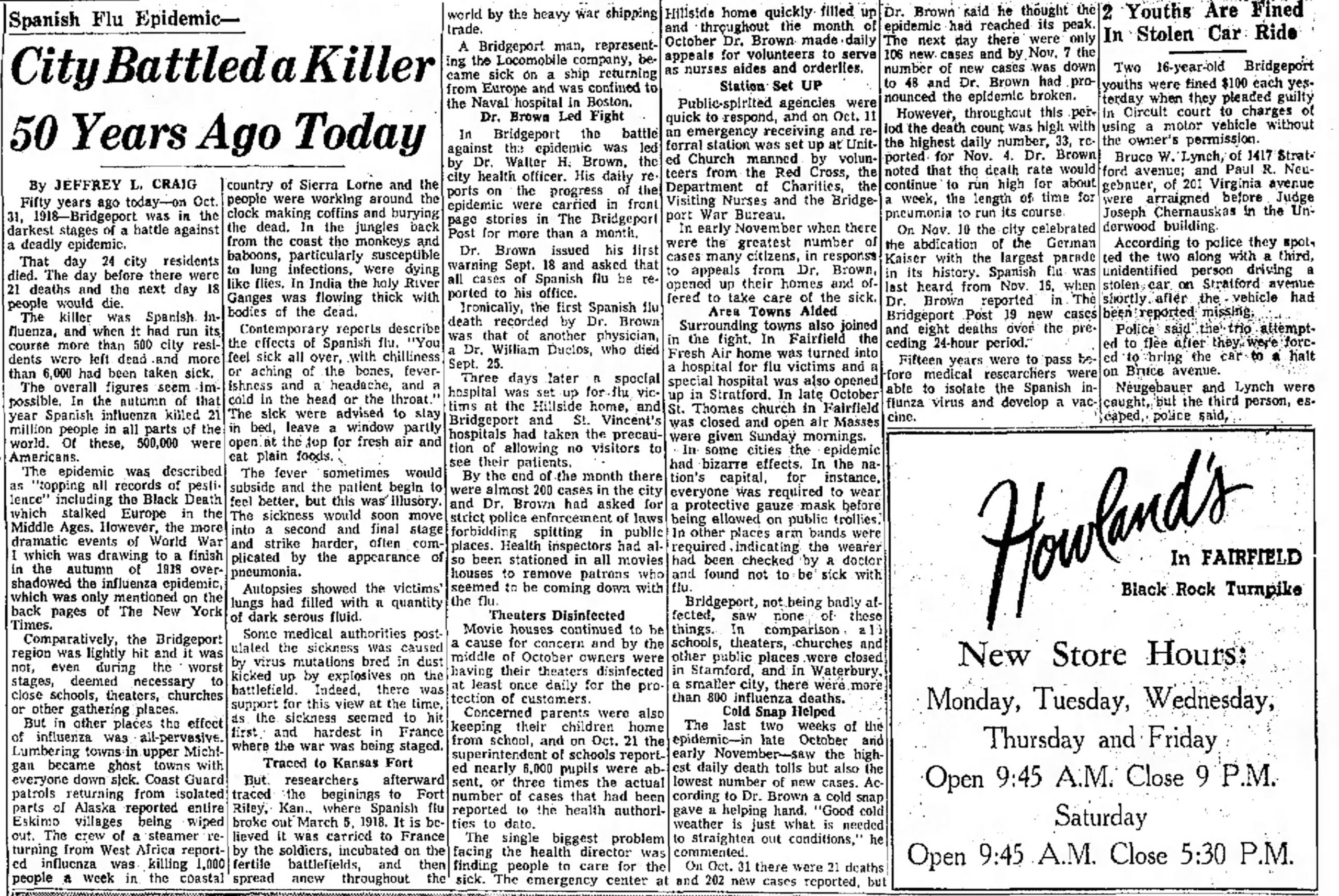
If you try to research newspaper articles on the pandemic of 1918 you would have difficulty as the news articles were mostly about World War I. I found an article from the Bridgeport Telegram dated October 31, 1968 on the 50th anniversary of the flu. The Center for Disease Control (CDC) is uncertain where the H1N1 flu strain originated. Some say Central Asia or like in this article cites Fort Riley, Kansas with its first case on March 15, 1918, where the flu spread throughout Europe by soldiers and sailors. Again, the world’s interest was World War I and the media at the time didn’t want to spread additional fears of the flu among soldiers and sailors so the reporting from Europe relied on independent country reports. Spain was the country that frequently reported their sick and the flu was dubbed the Spanish Flu. It is estimated that about 500 million people or one-third of the world’s population became infected with this virus. This flu was second only to the Black Plague of the middle ages.
The article said Bridgeport was lightly hit by the virus. October 31, 1918 had peak deaths of 24. The day before that was 21 and 18 before that. During the worst part of the flu schools, churches, theaters, and other gathering places. The article mentions of heavy death tolls in India with the Ganges River flowing thick with bodies of the dead. Also affected were monkeys and baboons in Sierra Lorne that were susceptible to lung infections.
Leading the fight in Bridgeport was Doctor Walter H. Brown, the city’s health inspector. A special hospital was set up for flu victims at the “Hillside home”. Bridgeport and St. Vincent’s Hospital did not allow visitors to see any of their patients. By the end of September, with almost 200 cases reported, Dr. Brown asked the police for strict enforcement of laws forbidding spitting in public places. Health inspectors also visited theaters to remove patrons who appeared to come down with the virus. By October the theaters were disinfecting the theater at least once a day. On October 21 the superintendent reported that over 6,000 students were reported to be absent from school.
Other cities like the nation’s capital required citizens to wear protective gauze masks before being allowed on the trolley. Other places required armbands for those indicating the wearer was checked by a doctor and found not to be sick with the flu. In late October, in nearby Fairfield St. Thomas Church was closed and open-air masses were given on Sundays. All schools, theaters, churches, and other public places were closed in Stamford and Waterbury.
A cold snap in late October and early November saw the highest daily deaths but also the lowest number of new cases. Dr. Brown said “Good cold weather is just what is needed to straighten out conditions”. Dr. Brown had thought the worst was behind the city. By November 7th the number of new cases was down to 48 and declared the epidemic broken.
On November 10, Bridgeport celebrated the abdication of the German Kaiser and held the city’s largest parade in history. The Spanish Flu was last reported on November 16 when Doc Brown reported just 19 new cases and 8 deaths over the 24 hour period. Fifteen years would pass before medical researchers were able to isolate the stain and develop a vaccine.
I’m happy to report the volume of calls EMS has been called to for our current pandemic has dropped off sharply from last week’s numbers.
The American Red Cross in Connecticut is launching a Virtual Family Assistance Center to support Connecticut families struggling with loss and grief due to the ongoing coronavirus pandemic.
People can visit redcross.org/vFACVirtual Family Assistance Center provides resources to those struggling with loss and grief due to the pandemicto access a support hub with special virtual programs, information, referrals and services to support families in need. The hub will also connect people to other community resources provided by 2-1-1, CT VOAD, and other partners. People without internet access can call 833-492-0094 for help.
“This is an incredibly difficult time for everyone, but especially for those who have lost a loved one due to COVID-19,” said Mario Bruno, CEO, American Red Cross in Connecticut and Rhode Island. “Not only have these families experienced the unexpected passing of a loved one but are also facing additional challenges caused by this public health emergency. We’re proud to work with our community leaders and partners to provide comfort and support to these families across Connecticut during these difficult times.”
Many families have experienced a disrupted bereavement and grief process due to restrictions related to COVID-19. To help, the Red Cross has set up a virtual team of specially trained mental health, spiritual care and health services volunteers who are:
Connecting with families over the phone to offer condolences, support and access to resources that may be available
Providing support for virtual memorial services for families, including connecting with local faith-based community partners
Hosting online classes to foster resilience and facilitate coping skills
Sharing information and referrals to state and local agencies as well as other community organizations including legal resources for estate, custody, immigration, or other issues
[Insert any specific local services here]
All Family Assistance Center support will be provided virtually, is completely confidential and free.
#HARTFORD, CT – Governor Ned Lamont today announced that due to the ongoing COVID-19 pandemic, he is ordering in-person classes at all K-12 public school facilities in Connecticut to remain canceled for the rest of the 2019-2020 academic year and continue providing distance learning during this period. Schools will also be required to continue providing meals to children under the school lunch and breakfast programs for consumption at home, as they have been throughout this emergency.
The governor is consulting with state and local education officials regarding whether summer school programming should commence as scheduled. He anticipates having guidance on that matter toward the end of this month.
Governor Lamont, State Department of Education Commissioner Miguel Cardona, and Office of Early Childhood Commissioner Beth Bye will discuss these issues during the governor’s 4:00 p.m. news briefing this afternoon.
“I know how important it is for so many students and teachers to finish out the school year, and I was holding out hope – particularly for high school seniors – that we’d at least be able to complete the final few weeks, but given the current circumstances and to protect everyone’s safety, it has become clear that it’s just not possible,” Governor Lamont said. “I want to thank the many educators across our state who have stepped up to provide remote learning during this time, as well as the many staff members who’ve been putting thousands of meals together for students each and every day.”
During the initial outbreak, Governor Lamont signed an executive order directing in-person classes at all K-12 public school facilities to be canceled effective March 17. That order was initially set to expire on March 31 but then was extended twice, most recently to May 20.
Upon the cancellation, the Connecticut State Department of Education immediately began working with every school district in the state to assess distance learning needs. A state team was formed to support districts that indicated having high or moderate needs in the area of distance learning. These teams have been in frequent communication with district leaders to offer and provide support and technical assistance. The state continues to provide vetted resources, guidance, and answers to questions on issues such as the Family Educational Rights and Privacy Act, attendance, grading, special education, and social emotional learning.
“The difficult decision to cancel classes for the remainder of the year is based on the health and safety of our students, their families, and our Connecticut communities,” Education Commissioner Miguel Cardona said. “While technology and remote learning will never replace the experience of our students in their school community, we are committed to constantly improving access to high-quality materials and connectivity for our students. Districts are working hard to find creative ways to celebrate the success of our seniors, as well as students who are transitioning from fifth and eighth grade. With the Reopen Connecticut Education Team, we are committed to preparing re-opening plans for summer school, as well as fall classes. While we do this, we also thank our dedicated educators today for their service to their students’ academic and social emotional needs.”
Governor Lamont will soon sign an executive order regarding today’s announcement. It will be publicly noticed and published on the governor’s website
shortly after he signs it.
Distribution of donated laptops and Scholastic books
The State Department of Education and the Governor’s Learn from Home Task Force have been continuing to coordinate the distribution of remote learning resources that have been donated to Connecticut, including 60,000 Dell laptops from the Partnership for Connecticut, and more than 185,000 high-quality Scholastic book packs for prekindergarten to eighth grade students from the Nooyi family. Due to global supply chain shortages during the pandemic, the laptops and book packs are arriving to Connecticut in staggered waves.
for the laptops in three rounds of delivery using a formula-based approach prioritizing equity, student need, and safe distribution. The first round of nearly 17,000 laptops, targeted for delivery around May 25, will be delivered to 19 districts where fewer than 60 percent of students have one-to-one device access at the school level. The staggered shipment plans are focused on connecting students who have been identified as in greatest need as soon as possible. Initial eligibility for the donated laptops was limited to high schools across the state’s Alliance District program. Once the needs were identified for those schools, eligibility expanded to include high schools beyond Alliance Districts where more than 40 percent of students quality for free or reduced-price meals.
The majority of the Scholastic book packs are expected to begin arriving from the manufacturer this week. Last week, the first shipments of 340 book packs arrived in Bridgeport schools, and 119 arrived at Bristol’s Early Childhood Center. Additional shipments to sites in Hartford and Norwalk are expected today and will continue over the next several days.
Connecticut schools have served four million meals under emergency meals programs
Throughout the emergency, Connecticut’s public schools have served more than four million meals to students under the emergency meals programs. A total of 130 school districts are currently serving meals at 458 locations statewide. In accordance with federal requirements, the state is operating two emergency meals programs:
· Under one program, certain school districts are authorized to serve meals only to students who attend their schools or any other child 18 years of age and younger residing in the same household.
· Under the other program, certain school districts are authorized to serve meals to any child 18 years of age and younger, regardless of which town or city the child lives or what school they attend.
Households should check with the individual school districts for information on the time and location the meals are being served, and further guidance regarding their distribution.