(Hartford, CT) – The Connecticut Congressional delegation today announced that Connecticut will receive an additional $10.6 million in regular Low-Income Home Energy Assistance Program (LIHEAP) funds to assist homeowners with their energy bills.
The $560 million in LIHEAP funds, of which Connecticut will receive $10.6 million, is administered by the U.S. Department of Health and Human Services (HHS) and comes at a time when energy assistance remains in high demand.
“Connecticut families should not have to choose between heating their homes, keeping the lights on or putting food on the table,” the delegation said in a statement. “This $10.6 million is a lifeline for Connecticut families and comes at a time when heating assistance programs are cutting back to meet surging demand for their services. We are pleased HHS released this funding and will keep fighting for robust investments in LIHEAP to provide real relief for Connecticut families.”
With this latest appropriation, Connecticut has received $116 million in LIHEAP funding since November 2022 through federal appropriations.
Individuals interested in applying for energy assistance can visit energyhelp.us or call the National Energy Assistance Referral (NEAR) hotline toll-free at: 1-866-674-6327.
This press release is made possible by:
The Town of Fairfield has been designated a member of the AARP Network of Age-Friendly States and Communities. Fairfield is one of seven towns in the state to become part of this network. AARP’snetwork, an affiliate of the World Health Organization’s (WHO) Global Network of Age-Friendly Cities and Communities Program is part of an international campaign to help communities prepare
for rapidly aging populations.
It is projected by AARP that by 2030, one of every five people in the U.S. will be 65 or older and
that by 2035, the number of adults older than 65 will be greater than the number of children under
18.
“Age-Friendly Fairfield is a town-wide initiative to further our efforts to make our community a great place to grow up and grow old,” First Selectwoman Kupchick said. “This exciting initiative will be a significant, comprehensive, and challenging effort, yet will provide immense benefits to the entire Town. I want to thank and acknowledge Human & Social Services Director Julie DeMarco, and Senior Center Director Brenda Steele, for spearheading this effort on behalf of the Town.”
As a member of the AARP Age-Friendly Network, Fairfield commits to assessing the challenges of its aging population and identifying policies, programs, and new ideas that will improve the quality of life for all ages in the community – in collaboration with residents, communities, and partners. Fairfield will gain access to national and global research, community networks, planning models and best practices to improve livability for all ages, abilities, and needs.
The three-to-five-year process looks at civic participation and employment, communication and information, community support and health services, housing, outdoor spaces, and buildings, respect and social inclusion, social participation, and transportation. There is no cost to becoming an Age-Friendly community.
The Age-Friendly Fairfield initiative, led by the Human Services Department in partnership with Fairfield Senior Advocates, will incorporate an advisory group of community stakeholders. “The process will begin with a comprehensive survey, coordinated by Fairfield Senior Advocates and
Fairfield University,” Human Service Director Julie DeMarco said, “as well as a listening session with residents to identify community age-friendly needs and opportunities.”
Town Department heads will also contribute to this process with their guidance and input.
Email AgeFriendlyFairfield@fairfieldct.org if you are interested in participating in the initiative or have any questions.
(Hartford, CT) – Attorney General William Tong today announced the filing of a lawsuit against Vision Solar, LLC following more than a dozen consumer complaints regarding predatory high-pressure sales tactics, misrepresentations about financing and tax credits, and unpermitted work that left homeowners saddled with nonfunctioning systems and unaffordable loans.
“We’re investigating numerous complaints regarding high-pressure solar industry sales tactics, but Vision Solar’s predatory practices are far and away the worst we have seen. Vision Solar preyed on low-income, elderly, and disabled homeowners, pressuring them into unaffordable loans for solar panels that in some cases were never activated. Their egregious misconduct appears to have violated multiple laws, and we’re going to hold them accountable. Our lawsuit seeks to get money back for Vision customers, as well as fines and court orders to stop Vision from engaging in these unfair and deceptive practices,” said Attorney General Tong.
Vision Solar began offering its services as a registered Home Improvement Contractor installing residential solar systems in December 2020. Since August 2021, the Office of the Attorney General has received 14 complaints. The complaints include reports that Vision representatives took advantage of elderly and disabled consumers, including pressuring them into signing contracts they were not fully able to read or understand. The Office learned that in one instance, a Vision salesperson selectively dealt only with an intellectually disabled individual despite knowing the other owner would not permit the solar installation. Other consumers complained that Vision completed work without applying for or obtaining necessary permits, leaving consumers with unusable systems that could not be connected to the grid.
Other complaints indicated that Vision altered the scope of work without consent, placing panels in unauthorized places that resulted in lower energy generation. Others stated that Vision overstated tax benefits, claiming that owners would receive federal tax credits despite knowing their income was too low to meaningfully benefit. Vision may also have applied for at least some of its town electrical permits falsely using the credentials of a licensed electrician no longer employed with Vision, and may have completed work on some solar systems without an appropriately licensed electrician.
The cost of affected consumers’ solar installation projects, which can include roof replacement, may be as high as $95,000. Given the high cost of solar panel installation, the complainants entered multiyear financing arrangements with third-party lenders selected and suggested by Vision. In some instances, Vision may have misrepresented consumers’ income to falsely qualify for financing.
Vision’s egregious misconduct likely violates both the Home Improvement Act and Connecticut Unfair Trade Practices Act. Today’s action seeks restitution for consumers, disgorgement of profits gained through the company’s unfair and deceptive acts, civil penalties, and injunctive relief blocking Vision from further illegal conduct.
Last year, the Office of the Attorney General and Department of Consumer Protection announced a similar investigation and enforcement action against Solar Wolf Energy over failures to complete, or even begin, promised work. Solar Wolf is currently blocked from doing business in Connecticut as a result of the ongoing investigation and has since filed for bankruptcy.
Assistant Attorneys General Joe Gasser and Lauren Bidra, Legal Investigator Caylee Ribeiro, Paralegal Specialist Casey Rybak and Deputy Associate Attorney General Mike Wertheimer, Chief of the Consumer Protection Section, are assisting the Attorney General in this matter.
The Office of the Attorney General and Department of Consumer Protection have previously released guidance regarding rooftop solar.
“Residential solar may help reduce electric bills and dependence on fossil fuels to power our electric grid, but consumers must proceed with caution. Solar power purchase agreements or lease agreements are often long-term, complex, and can be expensive. Any electric bill savings varies per household depending on many factors,” said Attorney General Tong. “While electric rates are high and we are all looking for ways to save money, consumers should never feel pressured into a solar contract or any other major home project.”
What must I know about rooftop solar?
• Not all homes are equally suited for solar. The size of the roof, orientation of the home, amount of sun exposure, and the home’s energy demands are all important factors to consider. Solar companies may ask about removing trees to increase sun exposure, which is an additional expense.
• Some roofs require reinforcement or replacement before solar installation. This is a separate cost that solar companies typically will not pay for. And, if roof work is required during the useful life of the system, the homeowner may have to pay to remove the panels.
• Compare reviews and prices. As with any major purchase, you should compare other consumers’ reviews of solar companies and shop around to be sure you’re getting a fair deal.
• Know who you are doing business with, and ensure they are properly licensed in Connecticut. Many solar companies contract out their marketing and installations to third parties, so you might be asked to sign a contract with a different company than you thought.
• Never sign any agreement with a solar company under pressure. The Attorney General’s Office and the Department of Consumer Protection have received complaints of high-pressure sales tactics by solar companies. Even if a salesperson suggests you sign to “get the process going” or to “get more information,” do not sign unless you are fully comfortable committing to the solar transaction. You should never feel pressured to read a contract quickly, let alone on the spot on a salesperson’s tablet or computer. And you may ask a visiting salesperson to leave your home at any time.
• Under Connecticut law, you may cancel your contract any time before midnight the third business day after a transaction.
Here are some frequently asked questions about residential solar systems:
What is a solar panel system?
A solar system consists of rooftop panels and an inverter which converts sunlight into electricity. Installing solar panels can be an intensive process: the system must be professionally designed and installed, permitted and inspected by local officials, and approved by the electric utility. Roof reinforcement or replacement may be required before installing a solar system, at additional cost to the homeowner.
The same consumer protection provisions apply to solar installers and salespeople as other home improvement contractors and salespeople. For more information, visit the Department of Consumer Protection’s website.
Is residential solar cost-effective?
The benefits and costs vary. Consumers should be wary of solar companies that promise that solar makes sense for them before carefully analyzing their situation. Never make a decision based on online calculations or estimates, which may be based on data from other parts of the country.
Salespeople will emphasize that the cost of electricity is high and increases every year. While electricity costs do increase, consumers should beware of promises by solar companies that a solar system can guarantee a certain level of savings. You can find historical electrical costs for your utility here.
Can I get a solar system at no cost?
No. There is no such thing as a no-cost solar system. While some solar installations may have no up-front cost, those options require monthly payments and may not be wise in the long run.
What about tax credits or other incentives?
There is a 26% federal tax credit on the cost of solar systems installed through the end of 2022. The credit drops to 22% in 2023 and expires in 2024 unless renewed by Congress. Only the purchaser of a solar system may take the tax credit, not lessees or PPA customers, and purchasers will only benefit if they owe federal income tax. While solar companies may advertise low cost or even “no cost” solar programs, these involve the solar company, not the homeowner, receiving any tax credit.
Who pays for the solar system?
• Purchase. Consumers can buy solar panels using cash or obtain financing. The consumer owns the system and generally is responsible for maintaining and repairing it. Only a purchaser can benefit from any applicable tax credits.
• Lease. Consumers can lease solar panels by paying a fixed monthly payment in exchange for the use of the solar panels for a set term. Much like a leased car, the consumer can buy the panels at the end of the term, give back the panels, or renew the lease. There is no guarantee that the lease payments will be less than the electricity bill would have been without panels. And, if the system does not generate enough to cover the home’s full energy use, there is still an electric bill.
• Power purchase agreement (PPA). Under a PPA, consumers do not own or lease their systems, but pay a monthly payment based on how much electricity they use. The cost per kWh is generally less than electric rates, but increases over time. As with a lease, there is no guarantee that the monthly payments will be less than the electricity bill would have been, and, if the system does not generate enough to cover the home’s full energy use, there is still an electric bill.
Will I still need to pay for power from the electric utility?
Homes with solar panels are still connected to the power grid. This means the homeowner pays for power from the electric utility unless their system produces enough to cover their energy needs. A residential solar system can send energy back onto the grid and, depending on the arrangement the homeowner selects with the electric utility, the utility will provide a credit if the home generates more power than it uses. More information about credits for solar generation is available here.
Does a solar system affect my home’s value?
Solar companies often claim that solar panels increase the value of your home. There is currently not good data to support this claim. Many home buyers do not see solar panels as a benefit. Also, homeowners with leased panels or PPAs may have difficulty selling their home since the new buyer and the company need to agree to transfer the lease or PPA.
Connecticut consumers who believe they have been harmed by a solar company’s practices should file a complaint with the Office of the Attorney General here: https://www.dir.ct.gov/ag/complaint/ or with the Department of Consumer Protection here: https://portal.ct.gov/DCP/Complaint-Center/Consumers—Complaint-Center.
(HARTFORD, CT) – On Friday morning, Governor Ned Lamont will hold a ceremony at the U.S. headquarters of Boehringer Ingelheim in Ridgefield, where he will sign an executive order requiring the formation of a blue-ribbon panel that will be charged with developing a strategic plan of recommendations on how Connecticut can improve its child care system with a particular emphasis on making it more accessible, equitable, and affordable. The governor will be joined at the event by Lt. Governor Susan Bysiewicz, Office of Early Childhood Commissioner Beth Bye, state legislators, childcare providers, parents, and advocates.
The governor is holding the ceremony at Boehringer Ingelheim because he wants to highlight one of the few businesses in the state that provides on-site childcare services to its employees, giving them a convenient and cost-effective method of receiving high-quality early childhood care and education just steps from where they work. Governor Lamont wants to encourage more businesses in Connecticut to offer child care services for their employees, which is why he proposed legislation this session that will provide businesses with a corporate tax credit of 25% of the cost of any child care subsidies they provide to their workers. The tax credit is included as part of his fiscal year 2024-2025 biennial budget proposal, which is currently under consideration in the General Assembly.
#Bridgeport CT–On 14 March 2023, the Tactical Narcotics Team served a search and seizure warrant on Moon Rock and Roll, a smoke shop, located at 4615 Main Street in Bridgeport, Connecticut.
The Tactical Narcotics Team entered the premises, observing over 75% of all visible products sold were some form of marijuana. The Tactical Narcotics Team arrested the owner, Wenke Chen of Corona, New York, and three employees: Avery Campbell of Bridgeport, CT, Tatiana Diaz of Stratford, CT, and Dabnus Ulmer of Bridgeport, CT.
The Tactical Narcotics Team also seized over 100 pounds of vacuum-sealed bags of marijuana, approximately 1700 pre-rolled joints, and hundreds of wax, pens, and edibles. Additionally, the Tactical Narcotics Team seized over $4700 in cash and various sales equipment. An investigation is ongoing pertaining to the scope of the operation.
Charges and Bond:
The owner, Wenke Chen was arrested for operating a marijuana dispensary without a license and possession with the intent to sell 1 kilogram or more of marijuana. He was held on a $10,000 bond.
The three employees were arrested for the illegal sale of marijuana and conspiracy to sell a controlled substance without a license. They were held on a $1000 bond.
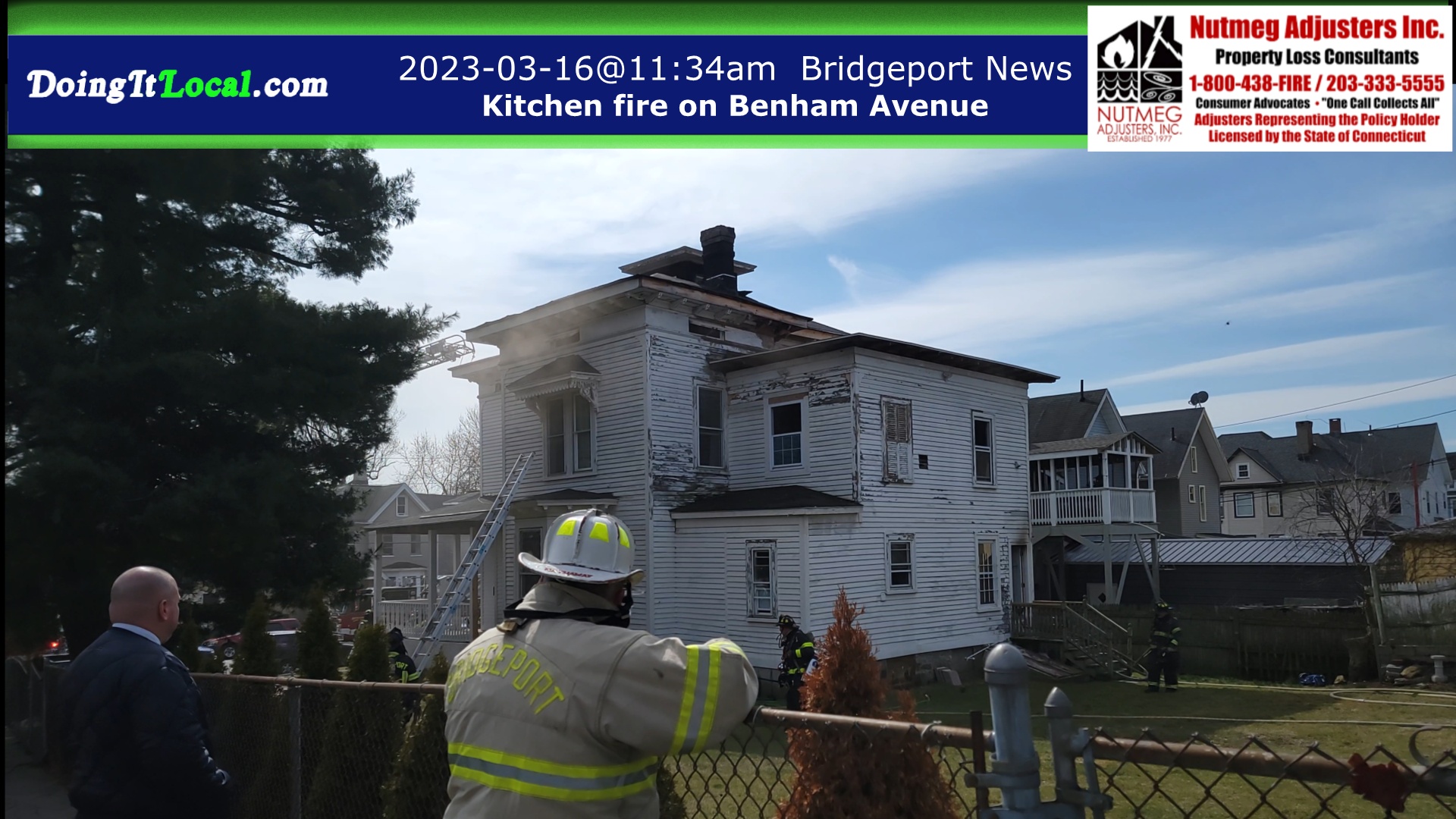
2023-03-16@11:34am–#Bridgeport CT– #ctfire– Bridgeport Firefighters were kept busy this morning, this time a kitchen fire on Benham Avenue. The fire was contained to the kitchen but the entire structure was filled with smoke and is deemed inhabitable. The Red Cross was called to assist those living in the home.
2023-03-16@10:12am–#Bridgeport CT– #ctfire– Bridgeport Firefighters were called to a structure fire on Elmsford Road. When they arrived the found heavy smoke and a bedroom on fire. They quickly extinguished the fire and ventilated the building. The Red Cross was called to the scene but the homeowners were able to make their own accommodations.
The Connecticut Department of Transportation (CTDOT) is alerting riders that due to track improvements on the New Canaan Branch Line this summer, substitute bus service will replace all train service. This necessary work is part of the tie replacement and track upgrades program. When completed, an existing speed restriction in the Stamford area will be eliminated. Train speeds through this section will increase from 30 miles per hour to 50 miles per hour, increasing travel times on the line. The track improvements, and bus substitution, will begin Tuesday, May 30, 2023, and is estimated to run through August.
“CTDOT has continued to move forward with projects that modernize and improve our state rail systems to bolster efficiency, safety, and overall customer experience,” said Connecticut Department of Transportation Commissioner Garrett Eucalitto. “We know the importance of this line and have plans to ensure passengers can reach their destination. We worked with Metro-North to ensure this outage begins after Memorial Day and concludes prior to Labor Day, coinciding with the time commuters and their families are more likely to have summer vacations planned. We appreciate the patience and understanding of our customers as we enter the final phases of work activity.”
The bus schedule is currently being finalized and will be shared in the weeks ahead.
This year, the construction program includes the New Canaan Branch Line’s replacement of approximately 8,000 ties with a Pandrol fastening system, 1,600 feet of rail, insulated rail joints, and bridge timbers over the Noroton River Bridge; remediation of mud spots at several locations; reinstatement of drainage along portions of the branch where needed; reinstallation new rail anchors as needed; and surfacing the entire branch line.
The New Haven Line Track 5 work to lift the speed restriction includes the replacement of 830 ties, 1,200 feet of rail and bridge timbers over the Canal Street Bridge, Elm Street Bridge, and East Main Street Bridge; surfacing the entire stretch; and maintenance of the railway turnout by Elm Street.
Customers will be able to access the complete substitute bus schedule at mta.info/mnr. Customers are encouraged to check the schedules and status of service before they travel.
All rail customers are encouraged to pre-purchase their rail tickets before boarding. Customers may use the MTA eTix app or ticket vending machines conveniently located at most New Haven Line stations. For information on how to use the MTA eTix app, visit mta.info/mta-etix.
While passengers are no longer required to wear masks on board trains or in stations, masks are welcome and remain an important preventive measure against COVID-19. Anyone needing or choosing to wear one is encouraged to do so.
2023-03-15@5:43pm– #Bridgeport CT– Injuries did not appear to be too serious in a crash between a car and motorcycle at Hancock and Fairfield Avenue. The driver of the car did stop (not seen in the picture).
#Milford CT–On March 11, 2023, officers responded to the Devon Motel for a disturbance. Officers spoke to the victim who stated that they got into an argument with Edwin Rivera of Bridgeport and they attempted to leave the room. Rivera grabbed them by the neck and slammed them onto the bed, where he held them down by the neck and refused to allow them to leave. The victim’s earring was ripped out of their ear during the struggle. The victim had injuries to their neck, ear and cheek. Rivera was charged with Assault 3rd Degree, Unlawful Restraint 2nd Degree, and Disorderly Conduct. BOND: $10,000