On October 4, 2022 Westport Police initiated an investigation after a complainant reported that they had a check fraudulently altered and cashed. The complainant provided the basic information of the incident, and the case was turned over the Detective Bureau. Through Law Enforcement sharing Westport Detectives were advised that Wilton Police had arrested Mr. Licona in September 2022 for similar financial crimes. At the time of his arrest, a laptop and cell phones were seized. Search warrants were executed on these devices and evidence from our larceny case was located on his electronic devices. An arrest warrant was signed and on August 3, 2023, Westport Detectives responded to Westchester Correctional Center and arrested Mr. Licona. He was transported to Westport Police Department where he was charged with the above crimes and released on a court set bond of $75,000.00
ARRESTED: Francisco-Licona, Henry AGE: 27 RESIDENCE: New York, NY CHARGES: Illegal Possession Personal Information Identity Theft 1st Illegal Trafficking in Personal Information BOND: $75,000.00
During May 2023, the Special Services Division began receiving information that Joshua Powell was selling large quantities of powder and crack cocaine that contained fentanyl within the City of Norwalk. An investigation was initiated into Powell’s narcotics trafficking enterprise. Over the next several months, investigators made several controlled narcotics purchases from Powell. As a result of their investigation, five arrest warrants were issued for Powell charging him with sale of a controlled substance. On August 10, 2023, at 7:30pm, officers from the Special Services Division observed Powell on Main Street. As Officers approached, he attempted to discard cocaine. Powell was taken into custody without incident. The cocaine seized during the arrest field tested positive for the presence of fentanyl.
Arrested: Joshua Powell, 30 of Stamford Charges: Sale of Narcotics and Possession of a Controlled Substance Bond: $100,000
Warrant charges: Five counts of Sale of Narcotics and Possession of Controlled Substance Bond: $750,000
(HARTFORD, CT) – Governor Ned Lamont today announced that Connecticut will hold Sales Tax-Free Week from Sunday, August 20, 2023, to Saturday, August 26, 2023.
During this one-week sales tax holiday, retail purchases of most clothing and footwear items priced under $100 are exempt from the Connecticut sales and use tax. The exemption applies to each eligible item costing under $100 regardless of how many of those items are sold to a customer on the same invoice.
“This tax-free holiday is scheduled at the perfect time to help families stretch their dollars during the back-to-school season, while also giving businesses an extra boost to their bottom line,” Governor Lamont said. “I encourage everyone taking advantage of these savings to shop at some of our state’s locally owned retailers and support Connecticut’s great small business community.”
“Sales Tax-Free Week is a great opportunity for Connecticut families to get their back-to-school shopping done and save money at the same time,” Lt. Governor Susan Bysiewicz said. “I encourage residents to take advantage of these savings and shop at their local small businesses, allowing those dollars to be reinvested back into their communities.”
“Shopping this week means real savings for Connecticut families as they prepare for the start of the school year,” Connecticut Department of Revenue Services Commissioner Mark Boughton said. “It’s a great opportunity to save on a variety of items while frequenting local small businesses. Our annual Sales Tax-Free Week is yet another way we’re helping Connecticut families save money.”
During the week, many retailers frequently choose to offer additional clothing and footwear discounts of their own, resulting in even more savings for shoppers.
(HARTFORD, CT) – Governor Ned Lamont today announced that he has signed into law legislation implementing procedures into state statutes that protect seniors from suspected cases of financial fraud, scams, and exploitation by a person who is taking care of an older adult.
Specifically, this law authorizes financial institutions to temporarily suspend or hold transactions involving an account of an adult over the age of 60 if there is a reasonable suspicion of financial exploitation, which is defined as taking advantage of an eligible adult by another person or caretaker for monetary, personal, or other benefit, gain, or profit. When such cases occur, the financial institution should disclose the suspected abuse to the Connecticut Department of Banking or the Connecticut Department of Social Services, who will investigate the report and refer it to law enforcement authorities if appropriate.
The law permits banks and credit unions to suspend or hold transactions on the account for up to 45 days. To encourage financial institutions to be vigilant in identifying these cases, those who act in good faith when suspending or holding a transaction will be immune from liability that might otherwise come from denying immediate access to an account holder’s money. This law takes effect July 1, 2024.
“Cases of financial exploitation and fraud involving caretakers of seniors is far too common and can result in an older adult having their savings depleted or lost entirely,” Governor Lamont said. “These cases are infuriating and heartbreaking, and we need to have strong laws in place that can prevent suspected abuse before a thief can access someone else’s money. By encouraging banks and credit unions to put a hold on transactions and report this kind of suspected abuse to authorities, we can add a strong layer of protections to prevent seniors from being financially exploited.”
Studies have found that more than 8.68 million incidents of elder fraud occur every year with an average loss per case of $20,015. In all 50 states, losses due to elder fraud total $113.7 billion each year. Deposit accounts are the most common product involved in these cases, followed by debit cards and credit cards.
“Elder financial exploitation is one of the fastest growing crimes across the country,” Connecticut Department of Banking Commissioner Jorge Perez said. “This bill aims to directly curb this activity here in Connecticut. Working with industry, advocates, and other stakeholders, we were able to put forward new tools that can have a meaningful impact on our senior citizens and give them additional protections for their assets.”
“Theft and exploitation are completely avoidable, and we will make sure our elderly population has the tools they need to evade such efforts,” Connecticut Department of Social Services Commissioner Andrea Barton Reeves said. “This added layer of security for our seniors will offer peace of mind to families knowing their loved ones are protected from financial exploitation. I am proud to have been a part of the many conversations we’ve held in Connecticut as we work to continue bolstering protections for seniors in every aspect of their lives.”
“We applaud this important legislation to address the issue of fraud,” Connecticut Department of Aging and Disability Services Commissioner Amy Porter said. “Involving new partners in fraud protection creates a stronger safety net within our communities.”
The legislation is Public Act 23-161. It was approved in the House of Representatives by a vote of 150 to 0 and in the Senate by a vote of 35 to 0.
State Representatives Jennifer Leeper (D-Fairfield, Southport), Cristin McCarthy Vahey (D-Fairfield, Bridgeport), and Sarah Keitt (D-Fairfield, Trumbull) today applauded the $162,000 grant announced for the Fairfield School District for school mental health specialists.
The funds will be broken up over three years, with the school district receiving $60,000 in 2024, $60,000 in 2025, and $42,000 in 2026.
The competitive grant comes from the federal American Rescue Plan Act (ARPA), and is meant to increase the number of mental health workers in schools.
“As Vice-Chair of the Education Committee, I have heard firsthand from parents and educators how important mental health is to the success of our students,” Rep. Leeper said. “Funding for mental health specialists is critical for every school district to have, and I’m thrilled to see these funds coming to the Fairfield School District.”
“All too often, students and families facing mental health challenges don’t know where to turn for help in the face of a crisis.” Rep. McCarthy Vahey said. “Thanks to Governor Lamont and our State Department of Education, this funding will help our school leaders support students and families so they know they’re not alone, and have another avenue to work through any issues they’re facing. I am grateful for the diligent work of our teachers and staff as they seek to help our students remain healthy, safe, and strong.”
“As Vice-Chair of the Children’s Committee, a member of the Public Health Committee, and the mother of a child in the Fairfield Public School system, I truly appreciate this funding to help our children navigate through the challenges they face” Rep. Keitt said. “Having a mental health specialist at school will be an invaluable resource for Fairfield families.”
Grant awardees must attend a formal training this month and complete compliance documents to receive the ARPA funding.
Rep. Leeper represents the 132nd District, which includes Fairfield and Southport, Rep. McCarthy Vahey represents the 133rd District, which includes Fairfield and Bridgeport, and Rep. Keitt represents the 134th District, which includes Fairfield and Trumbull.
STATE REPRESENTATIVES JENNIFER LEEPER, CRISTIN McCARTHY VAHEY, SARAH KEITT APPLAUD $162K GRANT FOR FAIRFIELD SCHOOL DISTRICT FOR MENTAL HEALTH SPECIALIST
State Representatives Jennifer Leeper (D-Fairfield, Southport), Cristin McCarthy Vahey (D-Fairfield, Bridgeport), and Sarah Keitt (D-Fairfield, Trumbull) today applauded the $162,000 grant announced for the Fairfield School District for school mental health specialists.
The funds will be broken up over three years, with the school district receiving $60,000 in 2024, $60,000 in 2025, and $42,000 in 2026.
The competitive grant comes from the federal American Rescue Plan Act (ARPA), and is meant to increase the number of mental health workers in schools.
“As Vice-Chair of the Education Committee, I have heard firsthand from parents and educators how important mental health is to the success of our students,” Rep. Leeper said. “Funding for mental health specialists is critical for every school district to have, and I’m thrilled to see these funds coming to the Fairfield School District.”
“All too often, students and families facing mental health challenges don’t know where to turn for help in the face of a crisis.” Rep. McCarthy Vahey said. “Thanks to Governor Lamont and our State Department of Education, this funding will help our school leaders support students and families so they know they’re not alone, and have another avenue to work through any issues they’re facing. I am grateful for the diligent work of our teachers and staff as they seek to help our students remain healthy, safe, and strong.”
“As Vice-Chair of the Children’s Committee, a member of the Public Health Committee, and the mother of a child in the Fairfield Public School system, I truly appreciate this funding to help our children navigate through the challenges they face” Rep. Keitt said. “Having a mental health specialist at school will be an invaluable resource for Fairfield families.”
Grant awardees must attend a formal training this month and complete compliance documents to receive the ARPA funding.
Rep. Leeper represents the 132nd District, which includes Fairfield and Southport, Rep. McCarthy Vahey represents the 133rd District, which includes Fairfield and Bridgeport, and Rep. Keitt represents the 134th District, which includes Fairfield and Trumbull.
(Hartford, CT) – Attorney General William Tong, the United States Attorney for the District of Connecticut, and the U.S. Department of Health and Human Services, Office of the Inspector General today announced that Optimus Health Care, Inc., a federally-qualified health center (“FQHC”) based in Bridgeport, has entered into a civil settlement agreement with the federal and state governments and has paid a total of $470,093.93 to resolve allegations that it submitted false claims to the Connecticut Medicaid program, and received overpayments from Medicaid for ineligible services.
Optimus Health Care, Inc. (“Optimus”) has 23 locations in southwestern Connecticut. As an FQHC, Optimus receives patient revenues and grants from the federal and state governments.
“Optimus Health Care repeatedly overbilled Connecticut’s Medicaid program, taking in payments they were ineligible to receive. I thank our federal partners at HHS-OIG and the U.S. Attorney’s Office for their coordination and assistance in protecting our public healthcare programs and tax dollars,” said Attorney General Tong.
The allegations against Optimus arise out of claims submitted to Connecticut Medicaid for dual-eligible beneficiaries. Dual-eligible beneficiaries are Medicare beneficiaries who are also eligible for Medicaid coverage. Some dual-eligible beneficiaries are eligible for, and receive, full Medicaid coverage in addition to their Medicare coverage. Other dual-eligible beneficiaries are known as Qualified Medicare Beneficiaries (“QMBs”). QMBs qualify for Medicaid to pay their Medicare co-pays, premiums, co-insurance, and deductibles.
The government alleges that Optimus submitted false claims to Connecticut Medicaid for dual-eligible beneficiaries with the incorrect Medicare denial codes. This caused Medicaid to pay claims it would have otherwise denied. The government also alleges that Optimus improperly billed Connecticut Medicaid for group therapy services for QMBs who were not eligible for reimbursement for those services.
To resolve its liability, Optimus paid $470,093.93 to the federal and state governments for conduct occurring between January 2014 and December 2020.
The False Claims Act allegations resolved by the settlement were originally brought in a lawsuit filed in the U.S. District Court in Connecticut by a relator, or whistleblower, under the qui tam provisions of the False Claims Act. These provisions allow private parties to bring suit on behalf of the government and to share in any recovery. The relator, a former employee of Optimus, will receive $62,787.78 as her share of the recovery. The case resolved by this settlement was captioned U.S. ex rel Migdalia Burgos, and the State of CT v. Optimus Health Care, Inc. (Docket No. 3:19-cv-652).
This matter was investigated by the Office of the Inspector General for the Department of Health and Human Services, and the Connecticut Office of the Attorney General. The case was prosecuted by Assistant U.S. Attorney Sara Kaczmarek and by Deputy Associate Attorney General Gregory O’Connell of the Attorney General’s Office. Legal Investigator Timothy Edwards also assisted the Attorney General in this matter.
Anyone with knowledge of suspected fraud or abuse in the public healthcare system is asked to contact the Attorney General’s Government Program Fraud Section at 860-808-5040 or by email at ag.fraud@ct.gov; the Medicaid Fraud Control Unit at 860-258-5986 or by email at conndcj@ct.gov; or the Department of Social Services fraud reporting hotline at 1-800-842-2155, online at www.ct.gov/dss/reportingfraud, or by email to providerfraud.dss@ct.gov.
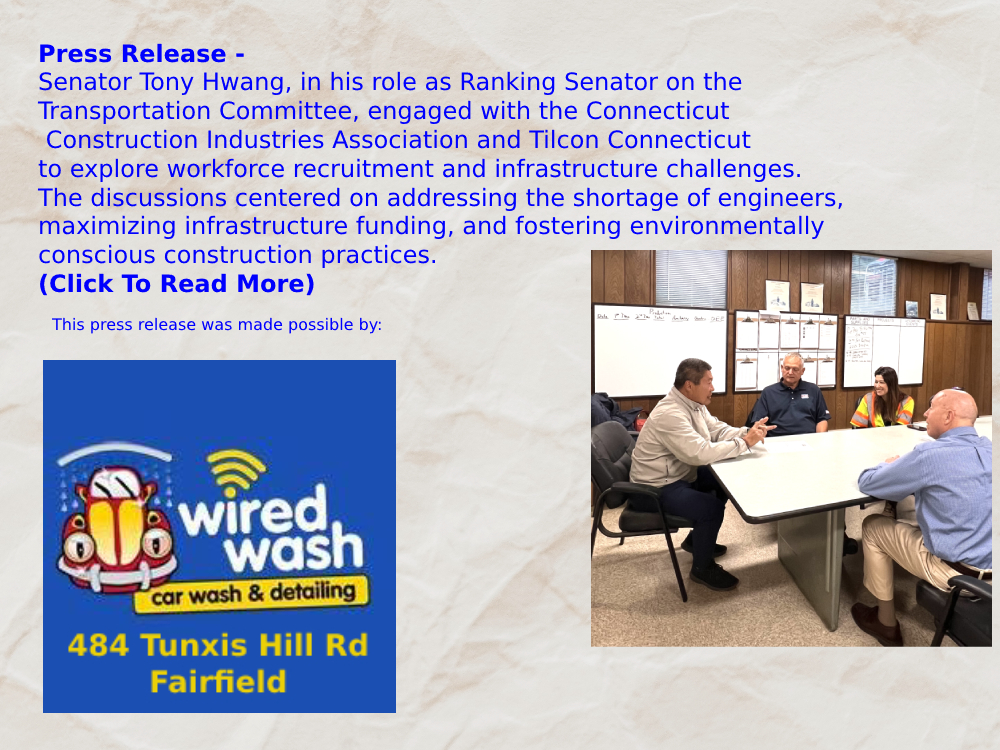
Sen. Tony Hwang, the Ranking Senator on the Transportation Committee, on Aug. 7 met with Connecticut Construction Industries Association (CCIA) President Don Shubert and Tilcon Connecticut President Carolina Cavalcante to discuss the industry’s challenges, innovations in transportation infrastructure improvements and workforce recruitment efforts.
“I wanted to hear firsthand from CCIA, which represents various sectors of the construction industry, and Tilcon, a business that has played a key role in building transportation infrastructure around the region,” Sen. Hwang said. “What I heard from these experts is this: The construction industry is not only hiring, but also anxiously looking to recruit and train the next generation of Connecticut workers. Tilcon, a division of CRH, for example, does business in my senate district in Newtown and throughout Connecticut. Tilcon CRH employs 600 workers statewide and is making connections between education and the workforce at technical high schools and union apprenticeship programs throughout Connecticut. I want to help them get the word out about their recruitment goals as well as the current impediments to their growth, both of which will impact job opportunities and business growth in Connecticut.”
Among the challenges: Federal infrastructure funding for Connecticut is not being immediately put toward road and bridge improvement projects. Part of the reason is a major shortage of engineers.
“Infrastructure investments are the highest return on investment for any government spending,” Shubert told Sen. Hwang, “So why are we not taking full advantage of this opportunity?”
“That’s a missed opportunity and it is frustrating for all of us,” Sen. Hwang said. “I have nothing but praise and admiration for the men and women who work in this industry and the difficult work they do, but we need to make that work available. These construction jobs make our economic engine hum. We must create momentum and keep that momentum going. At the same time, we must continue to expand the skilled-labor employment pipeline from technical high schools to this vital industry.”
Sen. Hwang said he plans to meet with the Connecticut Department of Transportation’s commissioner and municipal leaders to discuss action steps and progress timelines in order to get projects up and running and “shovel ready”.
Sen. Hwang learned about Tilcon’s internship program, which provides students the opportunity to attain a solid understanding about the company in a short timeframe. The Tilcon Connecticut internship is a robust experiential learning program and generally begins in May and runs through mid-August.
“Many of our former interns are now enjoying successful careers working for the Tilcon Connecticut family,” Cavalcante said.
Sen. Hwang also learned how companies like Tilcon put a priority on environmental protection.
“Preserving our precious natural resources, like watershed land, is top of mind for Tilcon,” Sen. Hwang said. “So, as they build and strengthen our infrastructure, they are also prioritizing environmental stewardship and clean water.”
Sen. Hwang said he would take what he heard and share it with lawmakers, the Governor’s Workforce Council, and the Lamont administration.
“CCIA and Tilcon Connecticut need to be heard at our State Capitol,” Sen. Hwang said. “Their feedback can help us accelerate job growth and our talent pipeline while improving our roads and bridges and protecting our environment. We need to listen – and we must act.”
Loopholes in current statutes allow anyone – including felons, traffickers, & extremists – to manufacture or assemble untraceable firearms using a 3-D printer or do-it-yourself kit
[WASHINGTON, D.C.] – U.S. Senator Richard Blumenthal (D-CT) and U.S. Representative Adriano Espaillat (D-NY) led a group of 26 lawmakers including U.S. Senator Chris Murphy (D-CT) in reintroducing the Ghost Guns and Untraceable Firearms Act, legislation to ban dangerous “ghost” guns. These weapons, which are easily assembled with a 3-D printer or a do-it-yourself gun making kit purchased from an unlicensed seller, can be obtained without passing a background check and have become the weapon of choice for criminals and extremists. Without a unique serial number, these guns are often untraceable and impede investigations by law enforcement. The bill would require online and other sellers of gun-making kits to comply with federal firearm safety regulations.
“Ghost guns are a major threat to public safety and law enforcement’s ability to protect our communities,” said Blumenthal. “Without serial numbers and readily available for anyone to assemble, these untraceable weapons are a convenient tool for those that hope to cause harm. Our measure closes the gaping loopholes that allow domestic abusers, criminals, and terrorists to bypass background checks. A homemade gun is still a gun. Subjecting these weapons to the same safety measures and requirements will save lives.”
“Gun violence has taken far too many lives and affected countless families around our nation,” said Espaillat. “Ghost guns are propelling this crisis, as these weapons are self-assembled, untraceable, and can allow criminals to evade firearm background checks. This has presented an ever-growing challenge for law enforcement agencies, as the number of ghost guns recovered at crime scenes has increased exponentially over the past few years alone. Our bill, the Ghost Guns and Untraceable Firearms Act, would codify the Bureau of Alcohol, Tobacco, and Firearms’ (ATF’s) authority to regulate and track these deadly weapons. We cannot ignore the public health implications facing the country as a direct result of ghost guns and our bill would implement commonsense solutions to help combat this crisis.”
“Illegal, untraceable ghost guns make it easy for criminals to get their hands on dangerous weapons. It makes no sense why a gun assembly kit should be treated any differently than a gun bought from a store. This legislation would bring federal law up to speed with the latest technology and stop the proliferation of ghost guns in our communities,” said Murphy.
The use of “ghost” guns across the country has been dramatically increasing. According to the Bureau of Alcohol, Tobacco, Firearms and Explosives, the number of “ghost” guns recovered and traced by law enforcement went from 1,629 in 2016 to 19,273 in 2021, a more than 1000% increase.
Specifically, the Ghost Guns and Untraceable Firearms Act would permanently include the core building blocks of “ghost” guns– unfinished frames and receivers –in the definition of “firearm” under federal law. In doing so, online and other gun kit manufacturers and distributors selling frames and receivers that can “readily” be converted into fully functional weapons would be required to comply with the same federal regulations that govern the production and distribution of completed firearms.
It also includes a requirement that sellers have a manufacturer’s license and put a serial number on the frame or receiver included in each kit, and that purchasers undergo a background check.
The Ghost Guns and Untraceable Firearms Act is cosponsored by U.S. Senators Chris Murphy (D-CT), Cory Booker (D-NJ), Ben Cardin (D-MD), Tom Carper (D-DE), Bob Casey (D-PA), John Fetterman (D-PA), Dianne Feinstein (D-CA), Kirsten Gillibrand (D-NY), Martin Heinrich (D-NM), Mazie Hirono (D-HI), Amy Klobuchar (D-MN), Edward J. Markey (D-MA), Bob Menendez (D-NJ), Jeff Merkley (D-OR), Alex Padilla (D-CA), Jack Reed (D-RI), Bernie Sanders (I-VT), Chris Van Hollen (D-MD), Elizabeth Warren (D-MA), Peter Welch (D-VT), and Sheldon Whitehouse (D-RI).
In the House, the bill is also led by U.S. Representatives Mike Thompson (D-CA), Madeleine Dean (D-PA), and Brad Schneider (D-IL).
The legislation is endorsed by the Everytown for Gun Safety, Brady: United Against Gun Violence, Giffords, and Newtown Action Alliance.
“Untraceable ghost guns, which can be obtained with no background check and no questions asked, are a dream come true for violent criminals and a nightmare for law enforcement,” said John Feinblatt, President of Everytown for Gun Safety. “Ghost guns look like a gun, shoot like a gun, and kill like a gun, so they must be regulated like a gun. We’re thankful to Senate Democrats for introducing legislation to do just that and we urge the gun sense majority in Congress to pass the Untraceable Firearms Act.”
“In recent years, the rise of unregulated ghost guns has had devastating consequences in communities all over the country. These unserialized and untraceable firearms are designed to evade public safety laws – like background checks – which ensure firearms cannot be obtained by those who are not legally permitted to have them, including gun traffickers, those convicted of violent felonies and domestic violence abuse, and minors. We cannot afford to wait. We must act now to stop the spread of these dangerous weapons. Brady is grateful to Senator Blumenthal for reintroducing this common sense bill to bolster public safety and the well-being of our communities,” said Kris Brown, President of Brady.
“Ghost guns can be obtained without a background check and intentionally lack serial numbers, meaning law enforcement has no clue where a gun came from when it is used in a crime. And with the gun lobby using the courts to block implementation and enforcement of the ATF’s rule regulating ghost guns, Congress must act to stop the alarming proliferation of these dangerous weapons. We applaud Senator Blumenthal for introducing the Untraceable Firearms Act to ensure that the key parts of ghost guns—the frame or receiver—are rightly regulated as firearms,” said Adzi Vokhiwa, Federal Affairs Director at GIFFORDS.
“According to the Bureau of Alcohol, Tobacco, Firearms and Explosives federal crime report, the number of suspected ghost guns recovered by law enforcement and submitted to the bureau for tracing increased by more than 1,000% between 2017 and 2021. It’s time for Congress to keep our children and families safe by passing the Untraceable Firearms Act to ban ghost guns to prevent criminals, domestic abusers, mass shooters, & other dangerous individuals from assembling their own untraceable weapons without background check, serial number, or sale record”, said Po Murray, Chairwoman of Newtown Action Allia
(HARTFORD, CT) – Governor Ned Lamont and Education Commissioner Charlene M. Russell-Tucker today announced plans to expand Connecticut’s free school meals program for the 2023-2024 school year, enabling more students to receive access to nutritious breakfast and lunch at no additional cost to them or their families.
Under the plan, $16 million of funding the state received from the American Rescue Plan Act will be invested into the program. Funds will be utilized to support the provision of meals at no cost in the following ways:
All students in non-Community Eligibility Provision (CEP) schools participating in the federal School Breakfast Program (SBP) will be able to receive breakfast meals at no cost, including day students within residential childcare institutions. Approximately 114 districts participating in the SBP are eligible to receive this funding serving an estimated 177,243 eligible students.
Students who are eligible for reduced-price meals in non-CEP schools participating in the federal National School Lunch Program (NSLP) will be able to receive lunch at no cost, including day students within residential childcare institutions. Approximately 128 districts participating in the NSLP are eligible to receive this funding, serving an estimated 13,197 eligible students.
The investment results from collaborative advocacy between the Governor’s Office, the Connecticut State Department of Education, legislative leaders, and strategic school nutrition partners.
“This investment ensures that each student begins their day with a nourishing meal, fostering learning and growth,” Governor Lamont said. “Additionally, removing the family portion of the cost of lunch for students eligible for reduced-price meals means more money in their pockets for other essential needs. By ensuring access to nutritious meals, we empower our students to excel academically and in all facets of life.”
“I commend Governor Lamont and our legislative leaders for placing priority on the continuation of free breakfast and school-lunch subsidies for Connecticut’s students,” Commissioner Russell-Tucker said. “Student health status, including physical health and student achievement, are directly connected. The research clearly shows that eating a nutritious and well-balanced breakfast improves concentration, alertness, and comprehension; results in fewer mistakes; assists with faster completion of math problems; results in better performance on standardized tests; and improves speed and memory on cognitive tests.”
Reimbursements to districts for meals served will be provided based on the approved eligibility status of each student – i.e., whether they quality for free, reduced-price, or paid meals.
(HARTFORD, CT) – Governor Ned Lamont, Connecticut Department of Administrative Services Commissioner Michelle Gilman, and Connecticut Department of Economic and Community Development Commissioner Alexandra Daum are recognizing Black-Owned Business Month, which is celebrated nationally each August. The commemoration provides an opportunity to acknowledge the resilience, innovation, and economic impact of Black-owned businesses in Connecticut and across the country.
“Our administration is proud to celebrate Black-Owned Business Month and acknowledge the many businesses across Connecticut that contribute to our communities and our economy,” Governor Lamont said. “By supporting small minority-owned businesses, we are strengthening our local economy and creating more job opportunities in our neighborhoods.”
“The Department of Administrative Services is committed to promoting inclusivity and economic growth by providing resources, services, and certifications to small and minority-owned businesses,” Commissioner Gilman said. “This month not only recognizes the economic contributions of Black-owned businesses but also highlights continued opportunities to expand our small business footprint across Connecticut. We encourage all small and minority owned businesses to become certified by our Supplier Diversity Team and learn about ways to contract with the State of Connecticut.”
“Black-owned businesses are a vital part of our economy for the jobs they create and the vibrancy they bring to our communities,” Commissioner Daum said. “In the past, many businesses – particularly small businesses – have had difficulties accessing resources to help them innovate and grow. The Lamont administration has taken a comprehensive approach to addressing this issue by investing in a number of grant and loan programs, including the Connecticut Small Business Boost Fund, and strengthening the state’s business support network.”
“The Minority Construction Council is proud to recognize and celebrate Black-Owned Business Month,” Jennifer Little-Greer, executive director of the Minority Construction Council, said. “Throughout the year, MCC collaborates with Governor Lamont, DAS, and DECD to advocate, support, and create development opportunities for minority contractors throughout the State of Connecticut.”
During Black-Owned Business Month and throughout the year, it is essential to actively support and promote black-owned businesses in Connecticut. Here are a few ways to contribute:
Patronize Black-Owned Businesses: Make a conscious effort to support black-owned businesses by seeking out their products and services. Explore online directories and local business associations to discover and engage with these enterprises.
Spread the Word: Utilize social media platforms and word-of-mouth to promote black-owned businesses you have personally experienced. Share their stories, reviews, and achievements to encourage others to support them as well.
Attend Community Events: Participate in local events, fairs, and markets that showcase black-owned businesses. This not only helps businesses gain exposure but also fosters a sense of community and solidarity.
Collaborate and Partner: If you own a business or work in a relevant industry, consider collaborations or partnerships with black-owned businesses. This can lead to mutually beneficial opportunities and contribute to a more diverse and inclusive business landscape.
The Procurement Division of the Department of Administrative Services manages the Supplier Diversity Program and offers other certification programs, technical assistance, and networking opportunities for small and minority-owned businesses. Small and minority-owned businesses economically benefit from certification with the state through government contracting and other private sector opportunities. Businesses that are interested in registering as small or minority-owned can do so through the Department of Administrative Service’s website.