Town of Fairfield Files Appeal in Superior Court Against Connecticut Siting Council Decision on Monopoles

If you want to look more into this, we had Senator Tony Hwang on On Patrol Live last Sunday where he talked about this pressing issue:

https://fb.watch/r2OOOPAUHJ/

Fairfield, CT, March 26, 2024--The Town of Fairfield has officially filed an appeal in Superior
Court challenging the legality of the Connecticut Siting Council’s decision dated February 16,
2024, granting United Illuminating (UI) a Certificate of Environmental Compatibility and Public
Need for the construction of overhead transmission lines along a new route to the north side of
Metro-North train tracks, entitled the “Hannon-Morissette Alternative.” The appeal comes after
months of Siting Council hearings where the Town and other impacted intervenors repeatedly
raised concerns about UI’s plan to install massive monopoles on the south side of the Metro
North train tracks and challenged whether there was any need at all for this project.
Throughout the proceedings in Docket 516, the Town argued that UI’s southern overhead design
would have caused devastating impacts to the environment and precious religious, cultural,
historic and scenic resources in the Town of Fairfield. The Town’s arguments prevailed before
the Siting Council, as not one Council member voted in favor of UI’s southern overhead design.
However, on February 16, the Council instead approved the Hannon-Morissette Alternative, a
double-circuit overhead route to the north side of the tracks. The Council approved this route
even though UI never presented a design for that option, and even though UI stated that siting its
transmission lines to the north was not viable.
The Town’s appeal raises two main arguments. First, the Town argues that the Siting Council
violated its statutory obligation to balance the supposed need for the project with the
environmental impact of a route to the north of the railroad tracks. Indeed, UI never submitted
any evidence of impacts on the properties abutting the north of the tracks, thereby making it
impossible for the Council to engage in this required balancing. Second, the Town argues that
the Siting Council violated due process as none of the abutters on the north side of the railroad
tracks had any notice of the Hannon-Morissette Alternative, and therefore were deprived of the
ability to exercise their right to participate in the hearing and contest this potential route. The
Town was also denied its due process rights to contest the merits of the Hannon-Morissette
Alternative, as UI never presented a design for this route to the Council. The Town asks the
Court to render a judgment vacating the Council’s decision.

Because UI never submitted a design of the Hannon-Morissette Alternative, the Town has no
information as to what the pole heights will be, where they will be located, and what the
potential impact will be to property owners on the north side of the tracks, including whether UI
would require permanent easements over private and Town-owned property.
“We believe that the Siting Council has failed to meet its obligation to satisfy the requirement to
balance the alleged public need with the environmental impact, and has done a disservice to our
residents,” First Selectman William Gerber said. “There was never any prior notice to any of the
abutting property owners to the north of the Metro-North Railroad tracks that UI may be
constructing new transmission lines to the north, nor did UI provide any evidence of the impacts
of this route, including whether property owners may now be facing permanent easements. This
is a blatant due process violation.”
He continued, “We are committed to fight for the rights of our community. Ratepayers as well as
residents have a right to understand and weigh in on the impacts of potentially having new giant
monopoles erected in their backyards.”
The Town of Fairfield remains steadfast in its commitment to protect the rights of its residents.


GOVERNOR LAMONT ANNOUNCES LAUNCH OF MICROTRANSIT SERVICES IN CONNECTICUT

https://www.doingitlocal.com/wp-content/uploads/2024/03/GOVERNOR-LAMONT-ANNOUNCES-LAUNCH-OF-MICROTRANSIT-SERVICES-IN-CONNECTICUT.mp4

Customers Can Request, Schedule New On-Demand Ride Services

(HARTFORD, CT) – Governor Ned Lamont and Transportation Commissioner Garrett Eucalitto today announced that new microtransit services will begin in various communities throughout Connecticut between March 26, 2024, and July 30, 2024. These services are part of a pilot program in which nine transit districts and municipalities were awarded funding through the Connecticut Department of Transportation (CTDOT) to develop and pilot on-demand microtransit service.

Microtransit service is an accessible, on-demand mode of transportation that allows customers to use a smartphone app or telephone number to request and schedule a ride within designated service areas. The pilot program will last for two years with the possibility of two one-year extensions exercisable by CTDOT, based on performance and ridership.

“This new program will help seniors and people with disabilities travel in parts of our state that have historically been underserved by public transportation,” Governor Lamont said. “These services allow people to use an app or phone number to request and schedule a ride within designated areas, connecting them to restaurants, entertainment, rail stations, airports, and critical services.”

“Microtransit brings public transportation to communities that have lacked fixed route bus service,” Commissioner Eucalitto said. “Thank you to Governor Ned Lamont and the state legislature for the continued investment in high-quality public transportation that eliminates gaps between communities and increases access and mobility throughout our state.”

On-demand microtransit services will begin on a staggered basis in the following locations:

Starting March 26, 2024

  • Norwalk Transit District: Serving Norwalk.

Starting April 1, 2024

  • Greater Hartford Transit: Serving Enfield and portions of East Windsor.
  • Southeast Area Transit (SEAT): Serving Groton.
  • Southeast Area Transit (SEAT): Serving New London.
  • Valley Transit District: Serving the Ansonia Train Station, Derby, and Shelton.

Starting April 6, 2024

  • Southeast Area Transit (SEAT): Stonington HOP, additional service hours on existing services to include Saturday service.

Starting April 8, 2024

  • Milford Transit: Serving Milford.

Starting April 22, 2024

  • Greater Bridgeport Transit: Serving Trumbull.

Starting May 6, 2024

  • Southeast Area Transit (SEAT): New London Smart: Service to include late night service on existing microtransit services.
  • Southeast Area Transit (SEAT): Serving Waterford.

Starting May 28, 2024

  • River Valley Transit (Estuary Transit): Serving Madison, Guilford, and portions of East Hampton and Middletown.

Starting July 1, 2024

  • City of Stamford: Serving a five-mile boundary within the city.

Starting July 30, 2024

  • City of New Haven: Serving the Hill, West River, Dwight, Edgewood, Beaver Hills, and West Rock neighborhoods with connections to existing transit services.

In addition to this new pilot program, existing microtransit services in Connecticut include XtraMile (River Valley Transit), Wheels 2U Norwalk and Wheels 2U Westport (Norwalk Transit District), and New London Smart Ride and Stonington HOP Service (Southeast Area Transit District).

For more information on all of Connecticut’s microtransit services, visit portal.ct.gov/dot/publictrans/bureau-of-public-transportation/microtransit-services.

The latest episode of Along the Lines, a podcast produced by CTDOT, discusses the pilot program and the benefits and transformative potential of microtransit in shaping the future of public transportation in Connecticut. This episode can be accessed at www.alongthelinesct.com.

BLUMENTHAL, MARKEY, & WARREN INTRODUCE LEGISLATION TO PROTECT CAR BUYERS & BOLSTER SAFETY OF USED CARS

[WASHINGTON, D.C.] – U.S. Senators Richard Blumenthal (D-CT), Edward J. Markey (D-MA), and Elizabeth Warren (D-MA) introduced legislation today to ensure the safety and reliability of used cars. The legislation, the Used Car Safety Recall Repair Act, requires car dealers to repair any outstanding safety recalls in used cars prior to selling, leasing, or loaning them to consumers. Current federal law does not prohibit car dealers from selling cars with open recalls, threatening the safety of everyone on the road. The Used Car Safety Recall Repair Act addresses this gap in consumer protections and better safeguards car buyers who often believe they are purchasing a vehicle with safety assurances.

“This bill makes sure that used cars with dangerous defects are repaired before they are driven on our roads,” said Blumenthal. “While many people believe the used cars they are purchasing are safe and reliable, that is all too often not the case. The Used Car Safety Recall Repair Act closes this glaring safety loophole, ensuring consumers have peace of mind when they get behind the wheel.”

“Whether a car is brand new or used, nobody should be at risk of purchasing an unsafe car,” said Markey. “And it doesn’t matter if a car is still on the lot or in a driveway, it needs to be made safe. I am proud to work alongside Senators Blumenthal and Warren on this important legislation to ensure unrepaired cars, subject to an outstanding recall, remain off our roads. Let’s close this loophole so that drivers, passengers, and pedestrians are safe once and for all.” 

With over 35 million used cars purchased in the United States in 2023, bolstering the safety of used cars remains an increasingly pressing issue. The Used Car Safety Recall Repair Act prevents the sale of used vehicles with safety defects by prohibiting auto dealers from selling, leasing, or loaning vehicles with unrepaired open recalls to consumers.

To ensure that open recalls are repaired, the Used Car Safety Recall Repair Act incentivizes auto dealers to swiftly repair recalls by allowing them to sell recalled vehicles to other dealers who have the ability to fix the defects instead of sitting in their lots. The legislation also requires manufacturers to provide dealers with parts to repair safety defects within 60 days or reimburse dealers if the manufacturers cannot provide the necessary parts.

The Used Car Safety Recall Repair Act is supported by a number of auto safety and consumer groups, including Consumers for Auto Reliability and Safety, Center for Auto Safety, Consumer Reports, Consumer Action, Advocates for Highway and Auto Safety, MASSPIRG, USPIRG, Safety Research and Strategies, Public Citizen, and Consumer Federation of America.

“No one should have to worry when they buy a car from a dealership that the dealer is deliberately selling them a hazardous, defective recalled deathtrap — whether it’s new or used. Senator Blumenthal’s bill is crucial for helping protect America’s used car buyers and their families from suffering devastating injuries or being killed. While used car buyers and their surviving family members do have important rights under state laws, those may not kick in unless someone has suffered damages or died. We still need NHTSA to be able to crack down on dealers who violate federal law, to help prevent tragedies from happening,” said Rosemary Shahan, President of Consumers for Auto Reliability and Safety.

“Millions of unrepaired and dangerous recalled vehicles are operated on America’s roads every day, threatening drivers, passengers and other road users. The widespread practice of selling these dangerous vehicles without first fixing obvious and identified safety hazards unacceptably shifts the burden from manufacturers and used car sellers onto the party least equipped to address the danger – the consumer. The Used Car Safety Recall Repair Act incentivizes manufacturers to get recall repairs completed quickly and protects everyone on the road by closing the federal loophole permitting the sale of unrepaired recalled used cars,” said Michael Brooks, Executive Director of Center for Auto Safety

William Wallace, associate director of safety policy for Consumer Reports, said, “At the bare minimum, people should be able to trust that a used car they’re buying is not coming to them with known, unrepaired safety defects—and right now, that’s not assured. Consumer Reports strongly supports the Used Car Safety Recall Repair Act. We urge every member of Congress to support the bill and press for it to become law expeditiously.”

“Many consumers will never buy a new car, and second-hand cars should not mean second-rate safety. An unrepaired safety recall can put road users at risk of death or injury, yet these tragic occurrences can be prevented by repair before resale. We commend Senators Richard Blumenthal, Ed Markey, and Elizabeth Warren, for reintroducing the Used Car Safety Recall Repair Act which ensures commonsense actions to keep vehicles with unrepaired recalls off the roads,” said Tara Gill, Senior Director, Federal and State Government Relations, Advocates for Highway and Auto Safety.

“This bill will put the brakes on the sale of dangerous used cars,” said Deirdre Cummings, MASSPIRG’s legislative director. “Consumers, rightly so, have the expectation that when shopping at used car dealerships they are being sold safe cars, and at the very least, they certainly would not expect for sale any car that is still under a safety recall.” 

“New cars can’t be sold with an open recall, why should used cars be an exception?  This bill is important to close the gap on safety and protect buyers,” says longtime safety advocate Sean Kane, of Safety Research & Strategies.

BRIDGEPORT POLICE MAKE SECOND ARREST IN VIOLENT ARMED ROBBERY OF EAST SIDE JEWELRY STORE – THIRD ARREST EXPECTED LATER THIS WEEK

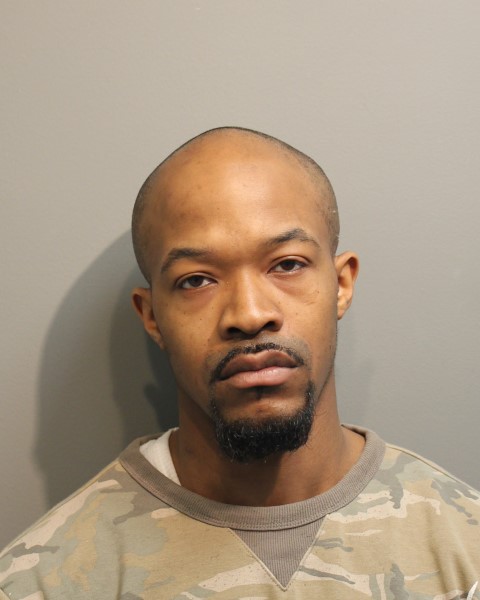
The Bridgeport Police have made significant progress in the case of the violent armed robbery at an East Side Jewelry store that occurred on June 10, 2023. On March 15, 2024, 32-year-old Adam Buster of Bridgeport was arrested at his place of employment in Shelton by the Bridgeport Regional Task Force Officers. Buster faces charges of Robbery in the First Degree, Assault in the Second Degree, and Larceny in the First Degree in connection with the robbery at ABC Jewelry on Boston Ave. His bond was set at $750,000. On March 20, 2024, Jermaine Ogrinc, 38, also of Bridgeport, currently held in custody by the CT Department of Corrections, was served with a warrant for his involvement in the same robbery. He faces charges of Robbery in the 1st Degree and Larceny in the 1st Degree, with bond set at $750,000. Additionally, a third suspect, Michael Stinson, 50, also of Bridgeport, is anticipated to be served with a warrant on March 22, 2024, for his role in the robbery. Stinson, currently in DOC custody on unrelated charges, faces similar charges of Robbery in the 1st Degree and Larceny in the 1st Degree, with a bond of $750,000 set by the court. The arrests come as the result of an extensive investigation by the department’s Robbery/Burglary Squad, with further progress expected in the near future.

https://www.doingitlocal.com/wp-content/uploads/2024/03/TheBridgeportPolic.mp4

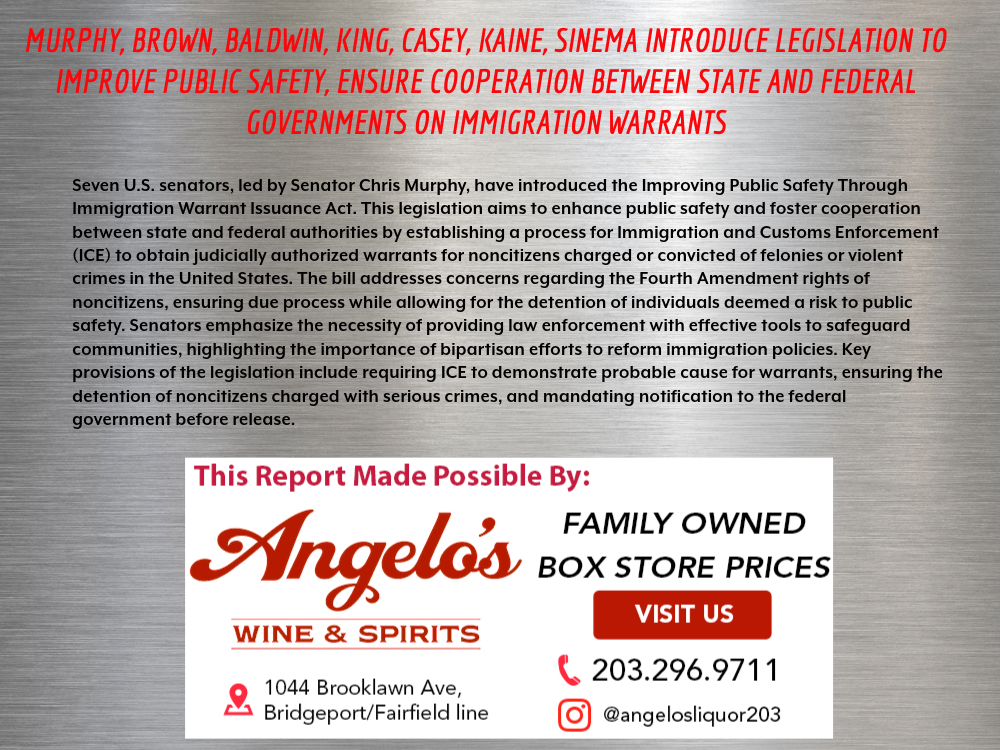
MURPHY, BROWN, BALDWIN, KING, CASEY, KAINE, SINEMA INTRODUCE LEGISLATION TO IMPROVE PUBLIC SAFETY, ENSURE COOPERATION BETWEEN STATE AND FEDERAL GOVERNMENTS ON IMMIGRATION WARRANTS

WASHINGTON–U.S. Senator Chris Murphy (D-Conn.), Chairman of the U.S. Senate Appropriations Subcommittee on Homeland Security, and U.S. Senators Sherrod Brown (D-Ohio)Tammy Baldwin (D-Wis.)Angus King (I-Maine)Bob Casey (D-Pa.), Tim Kaine (D-Va.) and Kyrsten Sinema (I-Ariz.) on Thursday introduced the Improving Public Safety Through Immigration Warrant Issuance Act, legislation to improve public safety and ensure strategic cooperation between state and federal governments by creating a mechanism that would allow Immigration and Customs Enforcement (ICE) to obtain a judicially authorized warrant for a noncitizen who has been charged or convicted of committing a felony or violent crime in the United States. Under the current system, when a noncitizen is charged by state or local law enforcement, ICE often issues an administrative request, known as a detainer, to hold the person in state custody until ICE arrives. However, because detainers are not authorized by a judge, state or local law enforcement cannot hold a person in physical custody longer than the period they would have been released or they risk violating that person’s Fourth Amendment rights.

“Even though we know immigrants are less likely to commit crimes than Americans, it is also true that there are times when ICE needs to take custody of a noncitizen accused or convicted of a serious crime. This proposal is a narrowly-tailored, commonsense solution to address that serious gap, while also preserving the due process rights of noncitizens. Unlike the bills proposed by House Republicans, this legislation would actually fix one of the problems facing our immigration system, rather than serve as a messaging tool to demonize immigrants. If Republicans are interested in anything other than political theater they should support this bill,” said Murphy.

“We need to do everything we can to keep Ohio communities safe and secure the border. That means making sure that local, state, and federal law enforcement have the tools they need to do their jobs,” said Brown. “With this legislation, we can make the changes necessary to ensure law enforcement can work together to protect the people they serve.”

“Wisconsinites should feel safe in their neighborhoods and know that law enforcement has the tools they need to do their jobs,” said Baldwin. “Our bill ensures that if a noncitizen is charged with a violent crime or could be a risk to our community, our state and federal law enforcement agencies can effectively coordinate to protect Wisconsin communities. This is a step in the right direction to fixing our broken immigration system and I am proud to be part of the solution.”

“We have a solemn obligation to keep our communities safe, and all criminals off our streets,” said King. “The Improving Public Safety Through Immigration Warrant Issuance Act isa commonsense step forward that will work to improve coordination between local, state and federal authorities regarding undocumented people who have been charged with or convicted of violent crimes. This legislation reinforces our commitment to public safety while we work toward a bipartisan solution to our nation’s insufficient immigration policies.”

“As families across Pennsylvania are increasingly worried about public safety in their communities, we need to make sure that violent criminals aren’t being released from custody because of a system that isn’t working,” said Casey. “This bill would give local and federal law enforcement the tools they need to better coordinate and keep perpetrators of serious and violent crimes off our streets.”

“Public safety is one of my top priorities,” said Kaine. “That’s why I’m joining my colleagues in calling for this commonsense step to ensure that federal and local law enforcement can work together to help protect communities from people who pose a genuine threat to public safety or national security.”

Specifically, the legislation would:

  1. Ensure due process and consistency with the U.S. Constitution by requiring ICE to show probable cause, which is the same standard that state and local governments must meet to obtain a criminal warrant;
  2. Ensure that individuals who have been charged or convicted of a felony, a crime of violence, including crimes against children, or who are a national security threat and are removable under the immigration laws, remain in physical custody as appropriate;
  3. Ensure that an entity holding a noncitizen, pursuant to a lawfully served warrant, notifies the federal government when such noncitizen is planned to be released.

Pizza Delivery Driver Robbed: Suspect Arrested in Norwalk

On February 24, 2024, at 11:00 PM, Norwalk Police Combined Dispatch received a distress call reporting a robbery involving a pizza delivery driver on Meadow Street. The incident occurred after a phone order was placed at a local restaurant for delivery to a specified address on Meadow Street. Upon arriving at the designated location, the delivery driver encountered an individual identified as Thompson. Thompson, purportedly armed and using intimidation tactics, proceeded to rob the driver by rifling through his pockets and seizing his belongings. Following extensive investigative efforts by the Norwalk Police Detective Bureau, the suspect was identified as Harlie Thompson, prompting the issuance of a warrant for his arrest. On March 20, 2024, Harlie Thompson voluntarily surrendered to authorities at the police headquarters. Thompson, aged 29 of Norwalk, was subsequently arrested and charged with Robbery in the First Degree. He was held on a $20,000 bond and is scheduled to appear in court on April 5, 2024.

https://www.doingitlocal.com/wp-content/uploads/2024/03/OnFebruary242024.mp4

Bridgeport News: Fire

At 12:43pm today, the Bridgeport ECC received c 911 call from a City of Bridgeport Public Facilities worker that there was a fire in the pit at the Asylum Street Transfer Station. BFD Units along with BPD were dispatched to the location. First on-scene Fire unit reported a working fire which was declared under control in approximately 25 minutes. No injuries occurred, DEEP and the gas company responded as well. The fire is currently under investigation with the Fire Marshal’s office.

BLUMENTHAL SPONSORS LEGISLATION TO CRACK DOWN ON PRICE FIXING ALGORITHMS THAT HELP PREDATORY LANDLORDS RAISE RENTS

[HARTFORD, CT] – U.S. Senator Richard Blumenthal (D-CT) joined Senate colleagues in introducing two new bills that would ban predatory practices by landlords who use pricing algorithms to avoid competition and raise rents.

https://www.doingitlocal.com/wp-content/uploads/2024/03/USSenatorRichard.mp4

Senator Blumenthal is a cosponsor of both the Preventing Algorithmic Collusion Act, which would prevent companies from using algorithms to collude to set higher prices, and the Preventing the Algorithmic Facilitation of Rental Housing Cartels Act, which would crack down on companies that help landlords increase rents in already high-priced markets.

“This practice affects housing throughout Connecticut. This kind of conscious collusion ought to be stopped. It is inflating rents for the ordinary person who goes to the landlord and is given a price that is based on an algorithm rather than real competition. Stifling competition ultimately means higher prices for renting apartments and homes here in Connecticut and all around the country,” said Blumenthal on Tuesday at a press conference at Greater Hartford Legal Aid.

The Preventing Algorithmic Collusion Act would prevent companies from using algorithms to collude to set higher prices. Price fixing and other forms of collusion are illegal under current antitrust laws. However, current antitrust laws may be insufficient when competing companies delegate their pricing decisions to an algorithm. This has already occurred in rental housing, and we must ensure that it does not spread to other sectors of our economy with the proliferation of algorithmic pricing.  To strengthen current price fixing law, this legislation would:

  • Clarify the law to make it easier to challenge algorithmic price-fixing and help antitrust enforcers stop algorithmic price-fixing before it occurs;
  • Increase transparency by requiring companies that use algorithms to set prices to disclose that fact and give antitrust enforcers the ability to audit the pricing algorithm when there are concerns it may be harming consumers;
  • Ban companies from using competitively sensitive information from their direct competitors to inform or train a pricing algorithm;
  • Direct the Federal Trade Commission (FTC) to study pricing algorithms’ impact on competition. 

The Preventing Algorithmic Collusion Act is led by Senator Amy Klobuchar (D-MN) and cosponsored by Senators Blumenthal, Ron Wyden (D-OR), Dick Durbin (D-IL), Peter Welch (D-VT), and Mazie Hirono (D-HI). The bill is endorsed by the Open Markets Institute and American Economic Liberties Project.

The Preventing the Algorithmic Facilitation of Rental Housing Cartels Act would crack down on companies that help landlords increase rents in already high-priced markets. These services allow landlords to collude to set prices via software and price-setting algorithms. The bill is led by Senators Wyden and Welch, and cosponsored by Senators Blumenthal, Klobuchar, and Hirono, as well as Senators Bernie Sanders (I-VT), Laphonza Butler (D-CA), Jeff Merkley, (D-OR), and Martin Heinrich (D-NM).

According to reporting by ProPublica and other news outlets, companies like RealPage and Yardi advertise their products as “property management software,” but in fact they help landlords in Connecticut and across the nation to coordinate prices to increase rental rates in the same market. The companies collect real-time price and lease information and in return suggest rent increases. The result is less competition and higher rent prices for consumers. RealPage, for example, says that it increases rents for client landlords between 5% and 12%.  This legislation would:

  • Make it unlawful for rental property owners to contract for the services of a company that coordinates rental housing prices and supply information, and designate such arrangements a per se violation of the Sherman Act;
  • Prohibit the practice of coordinating price, supply, and other rental housing information among two or more rental property owners;
  • Make it unlawful for two or more coordinators to merge where a merger creates an appreciable risk of materially lessening competition; and
  • Allow individual plaintiffs to invalidate any pre-dispute arbitration agreement or pre-dispute joint action waiver that would prevent their bringing a suit under this act.

The Preventing the Algorithmic Facilitation of Rental Housing Cartels Act is endorsed by the American Economic Liberties Project, the National Low Income Housing Coalition, and the National Alliance to End Homelessness.

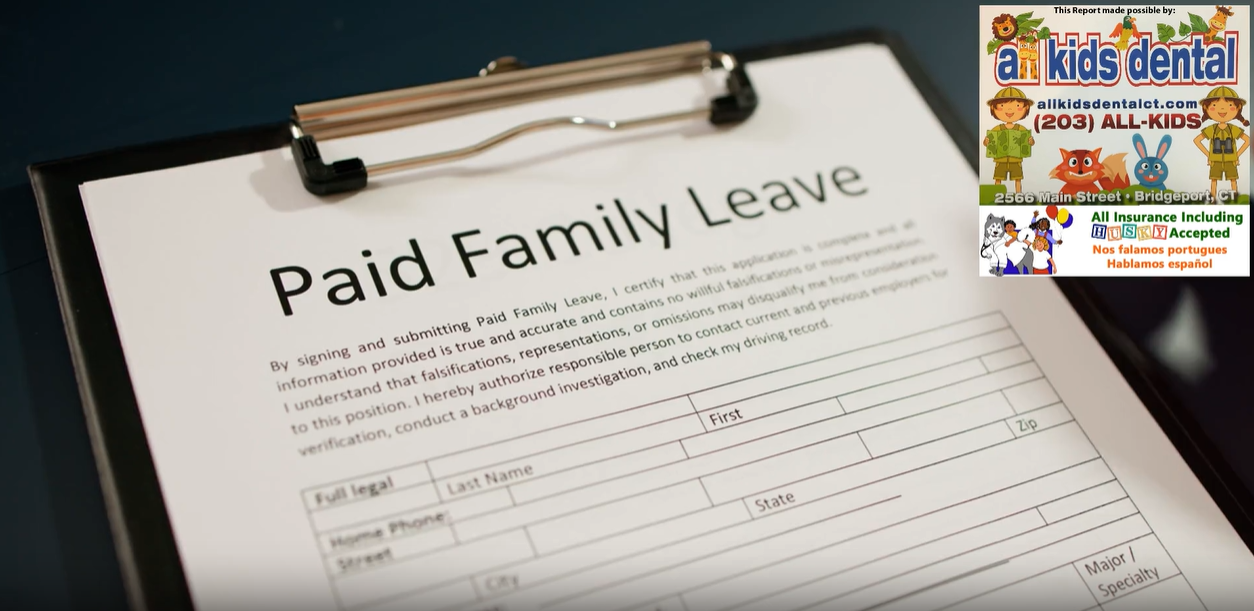
GOVERNOR LAMONT URGES APPROVAL OF LEGISLATION STRENGTHENING CONNECTICUT’S PAID SICK DAYS STATUTES

https://www.doingitlocal.com/wp-content/uploads/2024/03/GovernorNedLamont-4.mp4

(HARTFORD, CT) – Governor Ned Lamont is urging the Connecticut General Assembly to approve legislation he proposed for consideration this session that will expand and strengthen the state’s paid sick days statutes to ensure that more workers have the ability to take time off from work when they are sick or need to care for a sick family member without sacrificing a day’s wage or risk losing their employment. The proposal will also enact safeguards in these statutes for small businesses to ensure that the right to paid sick days is not being misused.

“Our current paid sick days laws include important protections for some workers, however there are broad categories of workers who are left unprotected,” Governor Lamont said. “If there’s anything we have learned from the recent outbreak of a viral pandemic, it’s that illness can spready quickly, and workers are sometimes left in a situation in which they have to choose between going to the workplace sick and risk spreading that illness to their coworkers and clients, or sacrificing a day’s wage and be unable to support themselves and their families. This proposal will modernize our paid sick days statutes and acknowledge the evolving landscape of work in a post-pandemic world.”

Under the governor’s proposal, these statutes would be modified by:

  • Requiring all employers to provide their employees with paid sick days, regardless of the number of employees who work for that employer. Under current statutes, only employers with more than 50 employees are required to provide paid sick days.
  • Expanding the definition of who qualifies as a family member when a worker wants to use their paid sick days to care for a loved one to include that worker’s parents and domestic partners. Under current statutes, workers are limited to using their paid sick days only to occasions when they are caring for themselves, their spouse, or their child.
  • Prohibiting employers from mandating the search for a replacement as a condition of a worker accessing their paid sick days.
  • Prohibiting employers from eliminating a worker’s accrued paid sick days in instances when an employer’s ownership has changed or because a worker’s jobsite has changed.
  • Enabling workers to use their paid sick days in certain instances related to the declaration of a public health emergency, such as when a public health authority has mandated the closure of a worksite or when a family member’s child care facility has been ordered closed due to a public health emergency.

Additionally, the governor is proposing to include protections for small businesses in these statutes by:

  • Clarifying that employers have the right to request reasonable documentation when an employee is using three or more consecutive paid sick days.
  • Affirming that employers have the authority to take disciplinary action in instances when paid sick days have been misused.
Exit mobile version