HARTFORD, CT) – Governor Ned Lamont announced that he received a revised policy statement from the Department of Revenue Services (DRS) updating its guidance of the recently adopted law on prepared foods sold in grocery stores in order to better reflect the intention of the legislature when it was adopted as part of the state budget earlier this year.
As a matter of routine practice, DRS creates policy statements like these whenever new laws the agency is responsible for enforcing are adopted so that residents and businesses can have a better understanding of how it recommends the statute be applied. Earlier this week, the governor directed DRS to review its guidance on the prepared foods law, expressing his concern that the agency’s initial interpretation of the statute exceeded the scope of the legislature’s action.
“The original guidance created by DRS was too broadly interpreted and not reflective of what was intended when the budget was passed. Businesses and residents depend on the guidance from these policy statements to better understand the real-world impact of legislation, and the update provided today gives a more accurate indication of how the statute on prepared foods should be applied,” Governor Lamont said. “I felt it important to act swiftly, but thoughtfully and thoroughly to ensure that what was enacted was implemented.”
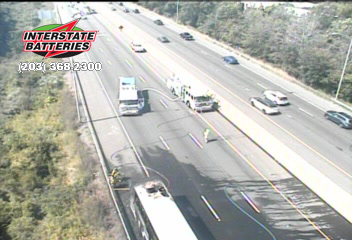
2019-09-20 @ 12:09am–#Milford CT–#cttraffic– First responders are on the scene on the Merritt Parkway near exit 54. Firefighters report the car is deep into the woods, every airbag deployed and a smashed windshield. Extrication underway.
2019-09-18@ 8:40pm–#Milford CT–#cttraffic–Tonight’s vehicle fire is being hosted in Milford on I-95 southbound near exit 40 where a car is fully engulfed in flames.
#Stratford CT—Michelle Pierce (DOB 07/13/1976) AKA Michelle Schmader of Stratford, CT was last seen in Oneida County, NY on 08/16/2019. She has a history of medical problems. She is an endangered missing person.
Information received suggests she could be in Rome, NY. She has no known connections in New York. Pierce is an African American female. Any information can be directed to Det. Jon Policano 24/7 via voice or text to 203-726- 0275
2019-09-02 @ 7:11pm– #Norwalk CT– A nurse at a home on West End Road called police because the person she is taking care of attempted to choke her because he is not to have cigarettes and demanded them from the nurse.
As summer draws to a close, back-to-school season is in full effect. Remember to safely share the roads with school buses, pedestrians and bicyclists, and provide children with the necessary knowledge to stay safe at school. Whether children walk, ride their bicycle or take the bus to school, it is extremely important that they – and the motorists around them – take proper safety precautions
Slow Down: Back to School Means Sharing the Road School days bring congestion: Yellow school buses are picking up their children, kids on bikes are hurrying to get to school before the bell rings, and hurried parents are trying to drop their kids off before work. It is never more important for drivers to slow down and pay attention than when kids are present – especially before and after school. If You’re Dropping Off Schools often have very specific drop-off procedures for the school year. Make sure you know them for the safety of all kids. More children are hit by cars near schools than at any other location, according to the National Safe Routes to School program. The
following apply to all school zones:
Don’t double park; it blocks visibility for other children and vehicles
Do not load or unload children across the street from the school
Carpool to reduce the number of vehicles at the school
Sharing the Road with Young Pedestrians
According to research by the National Safety Council, most of the children who lose their lives in bus-related incidents are 4 to 7 years old and are walking. They are hit by the bus, or by a motorist illegally passing a stopped bus. A few precautions go a long way toward keeping children safe:
Do not block the crosswalk when stopped at a red light or waiting to make a turn,
forcing pedestrians to go around you; this could put them in the path of moving
traffic
In a school zone when flashers are blinking, stop and yield to pedestrians
crossing the crosswalk or intersection
Always stop for a school crossing guard holding up a stop sign
Take extra care to look out for children in school zones, near playgrounds and
parks, and in all residential areas
Do not honk or rev your engine to scare a pedestrian, even if you have the right
of way
Never pass a vehicle stopped for pedestrians
Sharing the Road with School Buses
If you are driving behind a bus, allow a greater following distance than if you were driving behind a car. It will give you more time to stop once the yellow lights start flashing. It is illegal in Connecticut to pass a school bus that is stopped to load or unload children.
Never pass a bus from behind – or from either direction if you are on an undivided road – if it is stopped to load or unload children
If the red lights are flashing and the stop arm is extended, traffic must stop
The area 10 feet around a school bus is the most dangerous for children; stop far enough back to allow them space to safely enter and exit the bus
Be alert; children often are unpredictable, and they tend to ignore hazards and take risks
By exercising a little extra care and caution, drivers and pedestrians can co-exist safely in school zones.
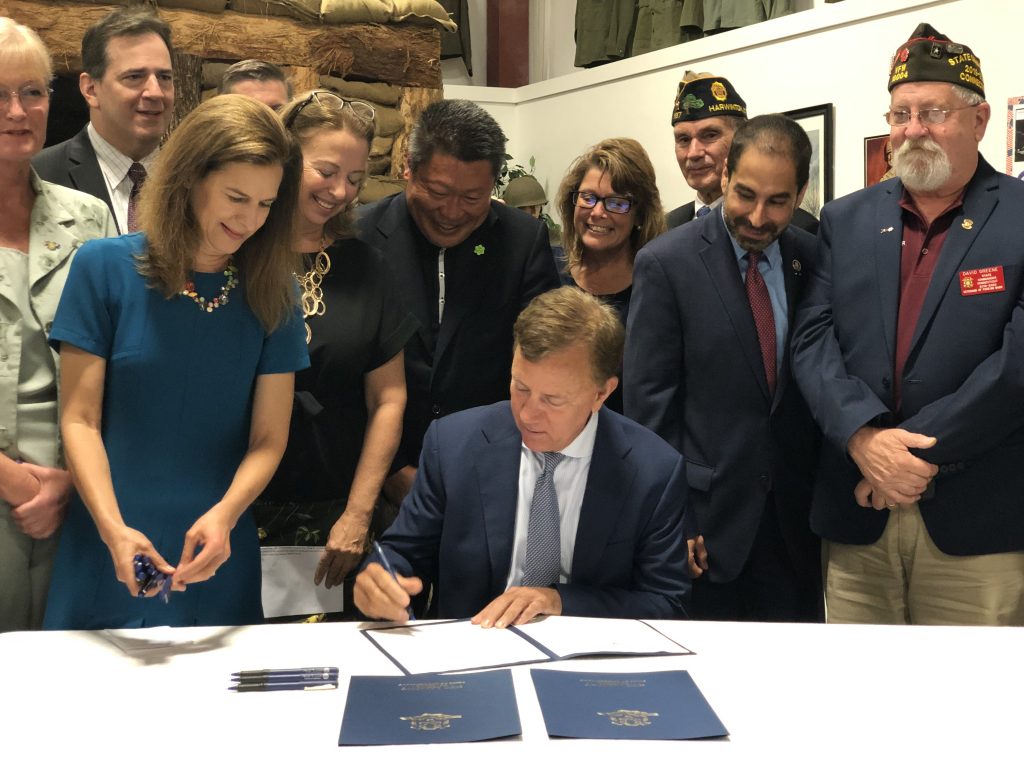
#WEST HAVEN, CT – Joined by military veterans, legislators, and advocates, Governor Ned Lamont today held a bill signing ceremony at the West Haven Veterans Museum and Learning Center to commemorate the enactment of three new laws adopted with the intention of expanding the ability of veterans to access certain state services and provide assistance after they have returned to civilian life.
The laws establish certain job training programs to assist veterans with the skills needed to obtain jobs in advanced manufacturing and other related positions; expand eligibility for veterans to receive certain state benefits; and provide greater property tax relief for veterans.
Governor Lamont said that his decision to sign the bills demonstrate the commitment of his administration and the state legislature to those who have served in the armed forces and deserve opportunity, recognition, and relief. Each of the bills were approved in both chambers of the Connecticut General Assembly by unanimous, bipartisan votes.
“The men and women of the military committed themselves to serve on behalf of our nation, and it is our responsibility to be there for them after they return to civilian life – whether that be immediately after they leave service, throughout the duration of their civilian careers, or well after a long-deserved retirement,” Governor Lamont said. “These new laws will expand programs that help our veterans obtain jobs and lead successful careers, provide some tax relief, and broaden eligibility to participate in programs that are provided to veterans by the state. These are thoughtful and needed services for our veterans, and I’m proud to sign them into law.”
“Connecticut has always been a state that takes care of its veterans and that’s not going to change,” Lt. Governor Susan Bysiewicz said. “Our veterans put their lives at risk to serve our country and to protect us, the least we can do is ensure that when they return home they have the necessary resources to take care of themselves and their families. Today, we are doing that by enacting three laws creating more education and employment opportunities for veterans, extending war service benefits, and increasing property tax exemptions for veterans with disabilities.”
“My thanks to the leaders and members of the General Assembly’s Veterans Affairs Committee and Governor Lamont for the great collaborative work with the Department of Veterans Affairs in passing a package of new laws supporting Connecticut veterans and their families, which include tax relief for disabled veterans, enhanced re-employment programs and increased access to residential and supportive programs and services at the state Department of Veterans Affairs,” Connecticut Department of Veterans Affairs Commissioner Thomas J. Saadi said.
Governor Lamont thanked the co-chairs and ranking members of the General Assembly’s Committee on Veterans’ Affairs, who played integral roles in advocating for the bills throughout the legislative process and getting them approved so that he could sign them into law.
“As co-chair of the Veteran’s Affairs Committee, I am pleased to see these important bills be signed into law,” State Senator James Maroney (D-Milford), co-chair of the Veterans’ Affairs Committee, said. “The Military to Machinist Program is a piece of legislation I authored, led passage of and am incredibly excited about. This law will assist veterans in making the often times challenging transition from military to civilian life easier and rewarding. In addition to helping our state’s courageous heroes, we are also strengthening the advanced manufacturing industry with committed, hard-working and intelligent veterans to join their strong and successful workforce. I am eager to see all the ways in which this will benefit our state’s heroes, who have sacrificed so much for our state and our country.”
“Connecticut service members deserve support from the communities they worked so hard to protect,” State Representative Dorinda Borer (D-West Haven), co-chair of the Veterans’ Affairs Committee, said. “The passage of these measures, which provide economic relief for our veterans, have been a long time coming and I am honored to have helped lead the charge in turning these ideas into policy.”
“The Committee on Veterans’ Affairs works in bipartisan fashion to improve the quality of life for Connecticut veterans and their families,” State Senator George S. Logan (R-Ansonia), ranking member of the Veterans’ Affairs Committee, said. “It is an honor to serve with my fellow lawmakers on this panel, and I commend the governor for signing these pro-veteran bills into law. We will always remain committed to helping our veterans, and we will always be grateful for their service.”
“I was proud to work on legislation that will help Connecticut veterans by providing access to life sustaining benefits they earned while protecting our freedoms, as well as policies to make it more affordable for disabled veterans to continue to live within our communities,” State Representative Kurt Vail (R-Somers, Stafford), ranking member of the Veterans’ Affairs Committee, said. “I want to thank my legislative colleagues on the Veterans’ Affairs Committee and the governor’s office for their steadfast work in making sure these concepts became state law.”
The bills include:
· Public Act 19-129, An Act Establishing the Military to Machinists and Veterans Platform to Employment Pilot Programs and Providing Other Employment Assistance to Veterans
o This bill requires the workforce development board for Connecticut’s southwest region to develop and operate a Military to Machinists pilot program that will assist veterans in earning an advanced manufacturing certificate from a qualifying program and secure employment in the field upon certificate completion.
o In addition, the board must develop and operate a Veterans Platform to Employment pilot program, which will provide training and subsidized employment for veterans who have experienced long-term unemployment, including skills assessments, career readiness workshops, and other tools.
o Finally, it requires the board to identify appropriate written materials on mental health conditions common to veterans that will be distributed to employers.
· Public Act 19-33, An Act Concerning the Definition of “Service in Time of War” and State Residency Requirements for Certain Veterans’ Services
o This bill extends certain state war service benefits to veterans who have served less than 90 days in a period of war because they incurred or aggravated an injury in the line of duty that is not a service-connected disability rated by the U.S. Department of Veterans Affairs.
o It also removes a prior law that required a two-year state residency eligibility for certain state benefits (e.g. hospital care and funeral expenses) for veterans who did not reside in Connecticut at the time of their enlistment or induction into the military.
· Public Act 19-171, An Act Concerning the Property Tax Exemption for Service Members and Veterans Having Disability Ratings
o This bill increases the base property tax exemption for certain disabled service members and veterans by $500. By doing to, it increases the additional income-based exemption for such service members and veterans by $250 or $1,000, depending on their income. This is calculated using the base exemption corresponding with an individual’s disability rating.
All three of the bills go into effect October 1, 2019.
2019-08-28 @ 12:40am–#Norwalk CT– Norwalk Police are investigating a shooting that took place off I-95 exit 16 on Connecticut Avenue. A person was shot 3 times by teens in a dark sedan.
2019-08-17 @ 2:00am–#Milford CT– Firefighters on scene of a car striking a building on Cherry Street. The building has significant damage according to radio reports. No reported injuries.