

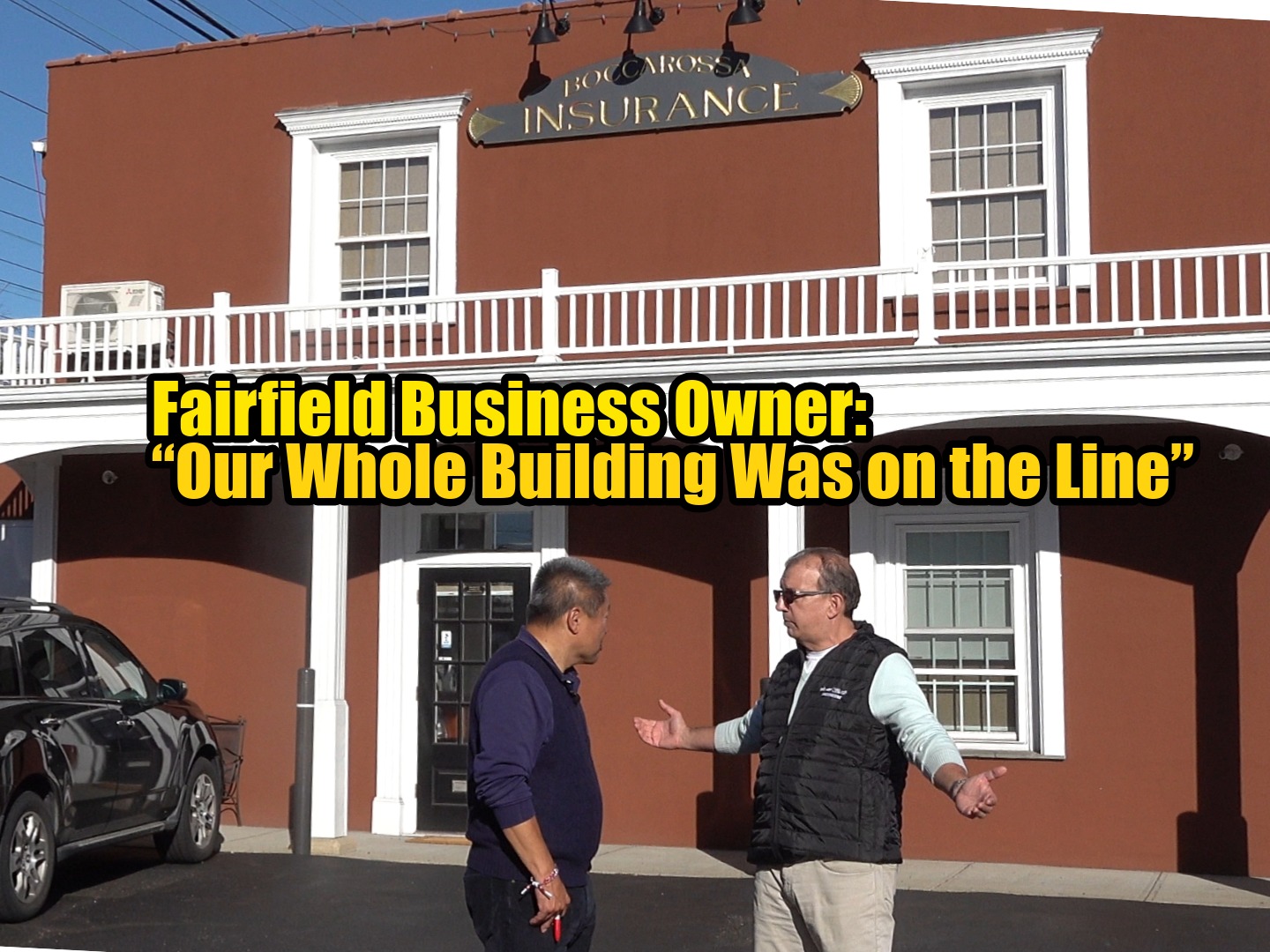
FAIRFIELD — With the Connecticut Siting Council’s denial of United Illuminating’s Docket 516R, Fairfield business owner Stephen Boccarossa says a weight has been lifted from his staff and customers—at least for now.
Boccarossa, who owns Boccarossa Insurance, said the company’s headquarters sat squarely in the project’s crosshairs. “Standing right here, the transmission line would have gone directly over the top of our building,” he said. “If an access road were added later, they could take the building. That’s how close this came.”
Beyond the physical route, Boccarossa said the risks extended into legal and financial territory that could threaten a small business’s survival. After consulting with colleagues, he said he learned of cases where property owners beneath high-voltage lines had to prove they could carry adequate liability insurance to cover potential injuries. “If you can’t demonstrate the proper coverage, there’s precedent to take the entire property,” he explained. “That’s unbelievable—and terrifying for any business owner.”
Boccarossa also took issue with what he described as a lack of transparency during the earlier hearing process. He said plans showed his entire parcel encompassed by a “work path,” yet he could not get a clear explanation of what that meant in practice. “When I see my whole property inside a work path, it looks like you plan to take my whole building,” he said. “I asked for an explanation—and got nothing. How is that fair?”
With Docket 516R now denied, Boccarossa expects a fresh application and a more accountable process. “Now they have to answer the questions,” he said. “New laws bring more accountability, and that matters not just for my property but for everyone along the line—today and in the future.”
State Senator Tony Hwang, who has supported affected residents and businesses throughout the fight, credited the decision to persistent community advocacy. He called the ruling “a people-first outcome” and said any future proposal must fully address safety, property rights, and local impact. “This was always about lives and livelihoods,” Hwang said. “Going forward, the process must respect that.”
Boccarossa agrees the community’s unity changed the trajectory—and could shape future infrastructure planning for years to come. “This isn’t just about one docket,” he said. “If the rules are stronger and the questions actually get answered, that protects a lot of people for a long time.”