WASHINGTON–U.S. Senators Chris Murphy (D-Conn.) and Mike Braun (R-Ind.), both members of the U.S. Senate Health, Education, Labor, and Pensions Committee, on Tuesday introduced legislation to strengthen consumer protections and improve transparency for medical debt practices. The Strengthening Consumer Protections and Medical Debt Transparency Act would require health care entities to communicate with consumers about any medical debt that is owed and reform collection practices. It would also direct the U.S. Department of Health and Human Services (HHS) to create a public database that collects information from health care entities about their debt collection practices. “No one should be forced into bankruptcy simply because they got sick. It’s unconscionable that there are hospitals willing to sue patients, seize their tax refunds, and even withhold care in order to get paid. This newly bipartisan legislation would protect patients from many hospitals’ overly aggressive, exploitative debt collection practices and bring some much-needed transparency to the industry,” said Murphy. “Many Americans are struggling with medical debt, and more transparency between health care entities
Category: State News
GOVERNOR LAMONT ACTIVATES CONNECTICUT’S EXTREME HOT WEATHER PROTOCOL
Cooling Centers Can Be Located by Calling 2-1-1 or Visiting 211ct.org
(HARTFORD, CT) – Governor Ned Lamont today announced that due to a weather forecast indicating that temperatures over the next several days are expected to be very hot and humid, he is directing Connecticut’s extremely hot weather protocol to be activated effective at 8:00 a.m. on Wednesday, July 26, 2023, and remaining in effect through 8:00 a.m. on Sunday, July 30, 2023.
The current forecast indicates that the heat index during this period will range at times between 95 to 105 degrees and have lingering impacts during the overnight hours, particularly in urban areas throughout Connecticut.
The purpose of this protocol is to ensure that the most vulnerable populations receive protection from the hot conditions. While enacted, a system is set up for state agencies, municipalities, and other partners to coordinate with United Way 2-1-1 to make sure that information regarding cooling centers is available statewide, providing a location to get some relief.
Governor Lamont is advising Connecticut residents, particularly those who are most vulnerable, to take precautions ahead of the high temperatures. Cooling centers are opening statewide. Anyone in need of a place to get out of the heat can locate their nearest cooling center by calling 2-1-1 or viewing the list online at 211ct.org.
“We’ve experienced a pretty warm summer so far, but it’s expected to get particularly hot this week, including during the evening hours,” Governor Lamont said. “Cooling centers are open throughout Connecticut and can be located by calling 2-1-1 or visiting 211ct.org.”
The following actions are implemented while Connecticut’s extreme hot weather protocol is enacted:
The Connecticut Department of Emergency Services and Public Protection’s Division of Emergency Management and Homeland Security uses its WebEOC communications network, which is an internet-based system that enables local, regional, and state emergency management officials and first responders to share up-to-date information about a variety of situations and conditions.
Municipalities and other partners submit information on the opening of cooling centers into the WebEOC, providing a real-time database on the availability of these locations statewide. United Way 2-1-1 uses the system to act as a clearinghouse to assist residents in locating a cooling center.
Regional coordinators from the Division of Emergency Management and Homeland Security monitor WebEOC in order to respond to any requests from municipalities for state assistance.
The energy utility companies provide the state with regular updates regarding the impact of the weather conditions on their respective utilities throughout the duration of the protocol.
Although anyone can suffer from heat-related illness, some people are at greater risk than others:
Infants and young children are sensitive to the effects of high temperatures and rely on others to regulate their environments and provide adequate liquids.
People 65 years of age or older may not compensate for heat stress efficiently and are less likely to sense and respond to changes in temperature.
People who are overweight may be prone to heat sickness because of their tendency to retain more body heat.
People who overexert during work or exercise may become dehydrated and susceptible to heat sickness.
People who are physically ill, especially those with heart disease or high blood pressure, or who take certain medications, such as for depression, insomnia, or poor circulation, may be affected by extreme heat.
Some prevention tips to stay safe in extreme heat include:
Keep your body temperature cool to avoid heat-related illness.
Stay in air-conditioned buildings as much as possible. If you must be outdoors, try to limit your outdoor activity to the morning and evening. Try to rest often in shady areas so that your body has a chance to cool off.
Find an air-conditioned shelter. (Call 2-1-1 for a list of cooling centers.) Do not rely on a fan as your primary cooling device.
Avoid direct sunlight.
Wear lightweight, light-colored clothing.
Take cool showers or baths.
Check on those most at-risk several times a day.
Pets that cannot be brought indoors should be provided ready access to water and shade to keep them cool.
Never leave pets inside of parked vehicles because temperatures can soar to life-threatening levels within minutes.
Everyone is also reminded to stay hydrated during periods extreme heat. Because bodies lose fluid through sweat, dehydration is common while experiencing very high temperatures. It is strongly encouraged to:
Drink more water than usual.
Don’t wait until you’re thirsty to drink more fluids.
Drink two to four cups of water every hour while working or exercising outside.
Avoid alcohol or liquids containing high amounts of sugar.
Remind others to drink enough water.
U.S. Department of Agriculture (USDA) in launching a partnership between USDA and bipartisan attorneys general in 31 states and the District of Columbia to enhance competition and protect consumers in food and agricultural markets
Attorney General William Tong joined the U.S. Department of Agriculture (USDA) in launching a partnership between USDA and bipartisan attorneys general in 31 states and the District of Columbia to enhance competition and protect consumers in food and agricultural markets, including in grocery, meat and poultry processing, and other markets.
Through a framework established in consultation with the state attorneys general, this new partnership will assist state attorneys general in tackling anticompetitive market structures in agriculture and related industries that are raising prices and limiting choices for consumers and producers. Agriculture Secretary Tom Vilsack announced the partnership at the White House Competition Council meeting, which marked the second anniversary of President Biden’s Executive Order on Promoting Competition.
“The Biden-Harris Administration is committed to addressing corporate consolidation and its negative effects on the U.S. economy, such as unfair competition and increased prices,” said Agriculture Secretary Tom Vilsack. “By placing necessary resources where they are needed most and helping states identify and address anticompetitive and anti-consumer behavior, in partnership with federal authorities, through these cooperative agreements we can ensure a more robust and competitive agricultural sector. I’m pleased to see that a bipartisan group of states have committed to joining USDA in better protecting the fair and competitive markets that are a critical cornerstone of the American economy.”
“Unfair competition in agriculture hurts families and farmers alike. Working with the USDA and bipartisan attorneys general nationwide, we are cracking down on price gouging, anticompetitive agreements, misuse of intellectual property, and other unfair practices that drive up prices, drive out farmers, and reduce access to healthy, affordable food for all of us,” said Attorney General Tong.
Building on the “whole of government” approach outlined in President Biden’s Executive Order on Promoting Competition in the American Economy, USDA issued a challenge to the state attorneys general to partner with USDA on competition in food and agriculture. This came after more than a dozen state attorneys general wrote to Secretary Vilsack requesting additional support for agricultural competition matters.
Background on Agricultural Competition Partnership
Under this new Agricultural Competition Partnership, USDA is investing in opportunities to combine state and federal authorities, expertise, and market insights. The agency is also leveraging funds to support complex cases and to jointly support research and academic work for use in future cases.
Focus areas of the Agricultural Competition Partnership include:
• Anticompetitive market structures and practices, as well as price gouging and other anti-consumer practices, in food, retail, meat and poultry processing, and other agriculture industries.
• Lack of choices for consumers and producers.
• Conflicts of interest, misuse of intellectual property, and anticompetitive barriers across the food and agriculture supply chains, such as in seed markets.
Specifically, this initiative will enhance the capacity of state attorneys general to conduct on-the-ground assessments of competition and consumer issues, enhance coordination between federal and state agriculture and competition authorities, create new and more independent research programs, and ultimately result in fairer and competitive markets and more resilient supply chains.
At the request of the states, USDA is partnering with the Center for State Enforcement of Antitrust and Consumer Protection Laws, a neutral, nonpartisan organization that provides similar support to the states. The State Center is establishing the necessary mechanisms for the attorneys general to cooperate with USDA. These mechanisms include an oversight committee to establish the project governance and transparency standards for the partnership, and a project selection advisory committee that will review project requests and recommend approval. Both committees will be composed of participating state attorney general offices. Additionally, USDA has engaged the American Antitrust Institute to be a resource for the states on this project.
$3.6 MILLION FOR BRIDGEPORT PUBLIC SCHOOLS
HARTFORD–U.S. Senators Chris Murphy (D-Conn.) and Richard Blumenthal (D-Conn.) and U.S. Representative Jim Himes (D-Conn.-04) announced that Bridgeport Public Schools will receive a $3.62 million grant from the U.S. Department of Energy’s Renew America’s Schools program to lower energy costs, create healthier and safer learning environments, and promote workforce development. This grant is funded by the Bipartisan Infrastructure Law.
“Bridgeport has one of Connecticut’s highest rates of asthma in children, and this $3.6 million from the Bipartisan Infrastructure Law will help lower harmful greenhouse gas emissions in the classroom. Not only will it make schools safer, healthier, and more energy efficient, it will also create good-paying union jobs and fund new apprenticeship opportunities,” said Murphy.
“Connecticut children deserve to breathe clean air. This significant federal funding will help Bridgeport upgrade their outdated HVAC systems to create safer, more energy-efficient environments for kids to learn and thrive. On top of all that good, this funding will allow Bridgeport to fund clean energy apprenticeship programs for students—doubling the impact of this $3.6 million investment. I am proud to see this funding headed to Bridgeport and I look forward to continued investments to support infrastructure upgrades in our schools,” said Blumenthal.
“Kids should be able to focus on their classwork without worrying about the quality of air they’re breathing. I am proud to bring funding from the Bipartisan Infrastructure Law home to Connecticut’s Fourth District to improve the health of our children with safer, greener infrastructure in our schools. With this investment, Bridgeport’s education system will become a statewide leader in energy efficiency, with the capabilities to foster a new generation of STEM students through engineering apprenticeship and internship programs,” said Himes.
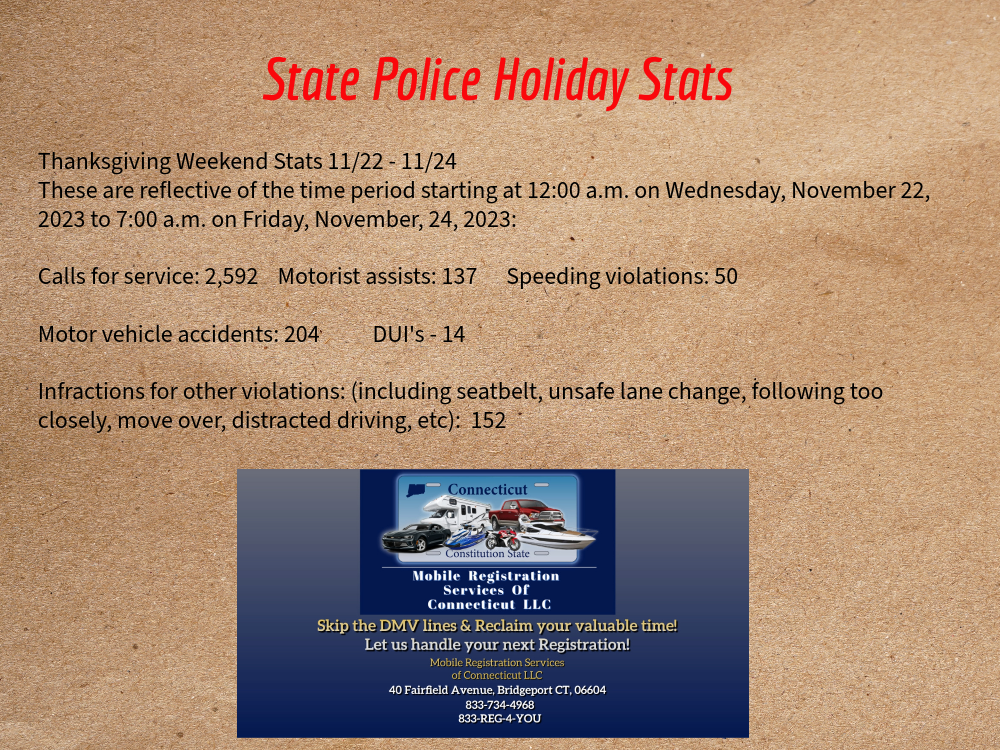
Connecticut State Police Final July 4th Stats
2023 Independence Day Weekend Enforcement Stats
(6:00 p.m. June 29 through 11:59 p.m. July 4):
Calls for Service: 7,312
TOTAL VIOLATIONS(to include unsafe lane change,
Following Too Closely
Cell Phone, Texting, Speeding, Seatbelt, etc.) : 835
SPEEDING: 485
SEATBELT: 18
DUI Arrests: 43
Motor Vehicle Accidents: 489
With injury: 49 (2 Serious: Stamford and Manchester)
Fatalities: 4 (Greenwich, North Canaan, Westbrook and Harwinton)
State Police Stats
The stats are reflective of the time period starting at 6:00 p.m. on Thursday, June 29, 2023 to 7:00 a.m. on Tuesday, July, 4, 2023.
Calls for Service: 6,186
Motor Assists: 275
Motor Vehicle Accidents: 411 Serious Injury (Stamford) Fatal: 1 (Greenwich, North Canaan)
DUI: 34
Speeding: 422 Citations
Citations (seatbelts, unsafe lane change, distracted driving, etc.): 730
NEW CONNECTICUT CAPTIVE INSURANCE LAWS
Public Act 23-15 Enhances Captive Insurance Companies
and Strengthens Support for the Industry
Connecticut Governor Ned Lamont, has signed into law Public Act 23-15, An Act Concerning Captive Insurance Companies, a groundbreaking piece of legislation aimed at bolstering the captive insurance industry in the state. The bill, championed by Commissioner Andrew Mais of the Connecticut Insurance Department (CID), marks a significant milestone in advancing a business-friendly regulatory environment that encourages innovation and supports the growth of captives to provide more options for businesses to manage their risk.
Public Act 23-15 introduces several key changes to Connecticut’s captive insurance laws, offering increased support and flexibility for captives, owners, and service providers.
The legislation, which will become effective on October 1, 2023, introduces the following significant provisions:
Risk Management and Unprecedented Coverage: The newly enacted legislation revolutionizes risk management by allowing captives to accept and transfer risks through parametric contracts. This innovative approach offers businesses coverage for unique and hard-to-place risks. Parametric insurance contracts offer certainty for planning purposes as they will pay out a predetermined amount based on the intensity or occurrence of a specific event. This concept provides businesses with a more efficient and customized method to mitigate risks that are uncommon or challenging to insure through the traditional commercial market.
Streamlined Operations for Sponsored Captives: P.A. 23-15 provides greater flexibility to sponsored captive protected cells enabling them to establish separate accounts to effectively address businesses’ specific insurance needs. This enhanced structure provides a comprehensive solution that aligns with the unique risk management needs of cell participants, while ensuring the protection of assets and liabilities within each account.
Dormancy Benefits for Captive Owners: This law provides benefits for owners of dormant captives. Captives that have stopped doing business and have no remaining liabilities can apply for a certificate of dormancy, resulting in exemption from paying Connecticut’s minimum premium tax. This exemption not only reduces the financial burden during inactive periods but also allows captives to be easily reactivated when market conditions or insurance needs change.
P.A. 23-15 builds upon previous legislative achievements from 2022, when the state implemented many other pro-captive laws, providing innovative solutions and increased flexibility for captives. These continued efforts have further positioned Connecticut as a leading domicile for captive insurance.
Connecticut’s achievements in the captive sector have garnered notable recognition through recent awards:
- Captive Review named Connecticut the Captive Domicile of the Year 2022 for written premiums under $5 billion.
- In its World Domicile Update for 2020 and 2021, Captive Review acknowledged Connecticut as the fastest-growing captive domicile.
- Connecticut experienced a 31% increase in captives in 2022 and is expected to maintain its position as leading domicile.
- Connecticut was honored as the 2022 Domicile of the Year by Captive International.
- Fenhua Liu, Captive Division Director, was featured on Captive Review’s Power 50 list in 2023, recognizing her influential role in the captive insurance sector.
Under Commissioner Andrew Mais’ and Assistant Deputy Commissioner Fenhua Liu’s leadership, CID has played a pivotal role in driving the success of Connecticut’s captive industry. The state has seen the emergence of four highly innovative InsurTechs/Managed General Agents (MGAs) forming captives in Connecticut, utilizing advanced technologies such as AI and blockchain to transfer risks or insure risks through parametric contracts.
“With the signing of P.A. 23-15 Connecticut reaffirms its commitment to maintaining a supportive and competitive captive insurance landscape. The new legislation, combined with the state’s recognized expertise, competence, and innovation, solidifies Connecticut’s position as a premier domicile for captives.” said Commissioner Mais.
BLUMENTHAL & SCHAKOWSKY INTRODUCE ROAD TO ZERO RESOLUTION TO END ROADWAY FATALITIES & IMPROVE TRAFFIC SAFETY
Traffic fatalities are the leading cause of death for Americans under 54, killing over 100 people every day
[WASHINGTON, D.C.] – Today, U.S. Senator Richard Blumenthal (D-CT) and U.S. Representative Jan Schakowsky (D-IL) reintroduced the Road to Zero resolution to reduce traffic fatalities and improve roadway safety for drivers, passengers, pedestrians, bicyclists, and others on the road. Introduction of the resolution follows yesterday’s announcement by the National Highway Traffic Safety Administration (NHTSA) that over 9,000 people died in traffic crashes during the first three months of 2023. By improving data collection and promoting access to safe, reliable transportation, the Road to Zero resolution aims to end roadway fatalities by 2050.
“Road to zero is reachable and responsible,” said Blumenthal. “Roads must be made safer for all—pedestrians and bicyclists, as well as car users. Improved technology and increased investment provide the opportunity—and imperative—to cut road tragedies.”
“For years, I have heard the heartbreaking stories of families impacted by car crashes and unsafe vehicles. Tens of thousands of lives are lost on our roadways each year. The United States is facing an auto safety crisis, one that we have the power to stop in its tracks,” said Schakowsky. “I am proud to reintroduce the Road to Zero Resolution with Senator Blumenthal. This resolution calls on the Department of Transportation to improve data gathering and tracking of traffic crashes and use a safe systems approach to prioritize transportation safety. We can help end these unnecessary deaths and injuries by 2050. All road users—drivers, passengers, pedestrians, and bicyclists—deserve to be safe on our nation’s roads.”
The Road to Zero resolution highlights the troubling number of traffic fatalities and crashes in the United States, with many of the deaths resulting from distracted and alcohol-impaired driving. The resolution also notes the deep history of inequality in the United States’ transportation systems as crashes have a disproportionate impact on people of color and low-income communities. Citing the success of seatbelts, speed limits, and other technology in preventing injuries and fatalities, the measure encourages federal agencies to implement interventions and improve data collection to prevent crashes.
While nearly 43,000 people lost their lives to traffic crashes in 2022, NHTSA’s data from the beginning of 2023 shows a decline in fatalities compared to the same time last year. This drop follows implementation of the Bipartisan Infrastructure Law, which included historic funding for transportation safety and the Safe Streets and Roads for All grants to address high-crash areas. The Road to Zero resolution seeks to build on this progress and achieve zero roadway fatalities by the year 2050.
The resolution is endorsed by the National Safety Council, Consumer Reports, Vision Zero, and Families for Safe Streets.
“The crisis on American roads impacts every road user who drives, bikes, walks and works. From improving road design, to advancing technologies, and changing driving behaviors, we all have a role to play in achieving our shared goal of zero traffic deaths,” said Lorraine Martin, National Safety Council president and CEO and chair of the Road to Zero Coalition. “This resolution places Congress’s support where so many states and communities already are—with the goal of zero fatalities. We thank Senator Blumenthal for his relentless commitment to zero, and urge all elected officials and community leaders to become champions of roadway safety efforts in their communities to save lives.”
“Consumer Reports urges every member of Congress to support the Road to Zero resolution. Auto crashes take a terrible and preventable toll, leaving countless families nationwide mourning those they have lost. If our country is going to make crash deaths a thing of the past—a goal that so many are working toward—then Congress absolutely must lead the way and commit to passing laws that put safety first,” said William Wallace, associate director of safety policy for Consumer Reports.
“There is more we can do to prevent roadway deaths and severe injuries — actions we can and should take at government and industry levels that will better ensure safe mobility for all of our loved ones across the nation. We have the opportunity and responsibility to prevent these tragedies. In honor of those who have lost loved ones or been injured in traffic crashes, we urge commitment and action with this resolution to advance Vision Zero — safe mobility for all,” said Leah Shahum, founder and director of Vision Zero Network, a national nonprofit foundation supporting safe mobility for all.
“Every traffic death is more than a number. Each has a bereft family and a heartbroken community. It has been almost 10 years since I lost my 12-year-old son Sammy. He was in 8th grade and just trying to get from school to soccer practice. This should not be a deadly act,” said Amy Cohen, Co-Founder of Families for Safe Streets. “Every one of us in FSS has lost a family member or suffered a life-altering injury. We are so grateful to Senator Blumenthal for urging the US to commit to ZeroTrafficDeaths. Taking that first step to a safety-first transportation policy will prevent others from the heartache we have suffered. The US is an outlier — the vast majority of nations like ours have dramatically reduced the number of people killed on their roadways. We have some of the most dangerous roads and most dangerous vehicles in the industrialized world and things are only getting worse. According to NHTSA, 42,939 lives were lost due to preventable crashes in 2021. This is a crisis, and we can and we must do better.”
$6 MILLION IN VOLKSWAGEN SETTLEMENT FUNDS TO EXPAND ELECTRIC VEHICLE CHARGING STATIONS IN CONNECTICUT
(HARTFORD, CT) – Governor Ned Lamont today announced that his administration is releasing more than $6 million from the legal settlement in the Volkswagen Corporation (VW) emissions cheating scandal to fund 54 electric vehicle supply equipment (EVSE) projects across Connecticut.
Administered by the Connecticut Department of Energy and Environmental Protection, the state is making these funds available for the installation of EVSE to encourage the use of electric vehicles. Approximately $1.8 million is being awarded for EVSE deployment at state government sites to advance the sustainability goals of Governor Lamont’s Executive Order No. 1, with an additional $3.3 million awarded for municipal projects, ten of which are located in environmental justice communities. Additionally, nearly $1 million is being dedicated to support non-government, public EVSE.
“I’m really proud of the investments we’re making in Connecticut’s future while driving down air pollution from cars and trucks at the same time,” Governor Lamont said. “The projects we are announcing today will go a long way in helping to improve air quality and protect public health throughout Connecticut, while also providing economic development opportunities.”
“The transportation sector is responsible for approximately 70% of smog forming air pollution and 40% of climate pollution in Connecticut,” Department of Energy and Environmental Protection Commissioner Katie Dykes said. “Expanding the availability of charging infrastructure around the state is critical to scaling up EV adoption.”
The transportation sector is responsible for approximately Connecticut’s 70% of smog-forming nitrogen oxide (NOx) emissions and 40% of greenhouse gas (GHG) emissions. This funding from the VW settlement will leverage utility sponsored incentives to support the growing number of electric vehicles and move the state closer toward meeting its health-based air quality standards, as well as its long-term climate goals, while at the same time creating economic development opportunities.
In 2015, Volkswagen publicly admitted that it had deliberately installed a defeat device – software designed to cheat emissions tests and deceive federal and state regulators – in nearly 590,000 VW, Audi, and Porsche model year 2009 to 2016 diesel vehicles sold nationwide, with nearly 12,000 vehicles sold in Connecticut. As a result of a federal civil enforcement case against VW for violating the Clean Air Act, Connecticut was allocated more than $55.7 million to be distributed over a ten-year period for use toward offsetting the excess NOx pollution emitted in the state by these vehicles.
NOx combines with organic compounds in the air to the form ground level ozone, an air pollutant known to cause a number of adverse respiratory health effects, including significant decreases in lung function and inflammation of airways. Ozone forms when NOx and volatile organic compounds from combustion sources like motor vehicles react in strong sunlight. The Department of Energy and Environmental Protection continues to implement emission control programs to mitigate ozone’s negative impact on public health in Connecticut.
The fifty-five projects selected for funding under this funding cycle, over their lifetime, will cost-effectively reduce 2,760 tons of NOx emissions and almost 126,000 tons of GHGs from environmental justice communities and other areas of Connecticut that bear a disproportionate share of air pollution. The projects were selected from 87 submitted proposals for 163 projects at 181 individual sites (addresses) and included 24 state government projects, 50 municipal government projects, and 89 private (non-government) projects.
With the $6 million of this funding round, a total of $35 million of Connecticut’s VW settlement funding has been awarded to support more than 100 clean air projects statewide.
FTC AMENDMENTS TO PROTECT CONSUMERS FROM DECEPTIVE AUTO-RENEWALS
(Hartford, CT) – Attorney General William Tong and a coalition of 26 state attorneys general submitted comments in support of Federal Trade Commission amendments to the Negative Option Rule protecting consumers from deceptive auto-renewal programs.
Negative options are marketing methods for companies to enroll consumers in subscriptions, continuity plans and programs, automatic renewals, and other reoccurring actions. These plans and programs do not require consent for each attached reoccurring charge; rather, in some cases, a consumer’s silence is consent.
Amendments to the existing Negative Option Rule would provide more protection to consumers, clarifying terms at enrollment, offering easy and immediate cancellation options, and reminders of upcoming charges.
“My office has numerous complaints from consumers unwittingly lured into expensive subscriptions that they cannot cancel. It’s far too easy right now for sellers to bury fine print and trick consumers into these unwanted renewals and recurring charges. That shouldn’t be. The FTC has proposed a straightforward rule—sellers need to obtain clear consent before charging consumers. I fully support these pro-consumer reforms,” said Attorney General Tong.
The comment letter was filed on June 23 in response to an FTC notice of proposed rulemaking. In the notice, the FTC sought comment on the following proposed amendments:
• Applying the Rule to all forms of negative option marketing;
• Prohibiting misrepresentations of any material fact regarding the entire agreement;
• Requiring clear and conspicuous disclosures of certain information before obtaining consumer’s billing information;
• Requiring sellers to obtain express informed consent before charging consumers;
• Requiring sellers to provide a simple mechanism for consumer to cancel a negative option subscription; and
• Requiring sellers to provide reminders concerning the frequency and amount of charges, and the means to cancel.