


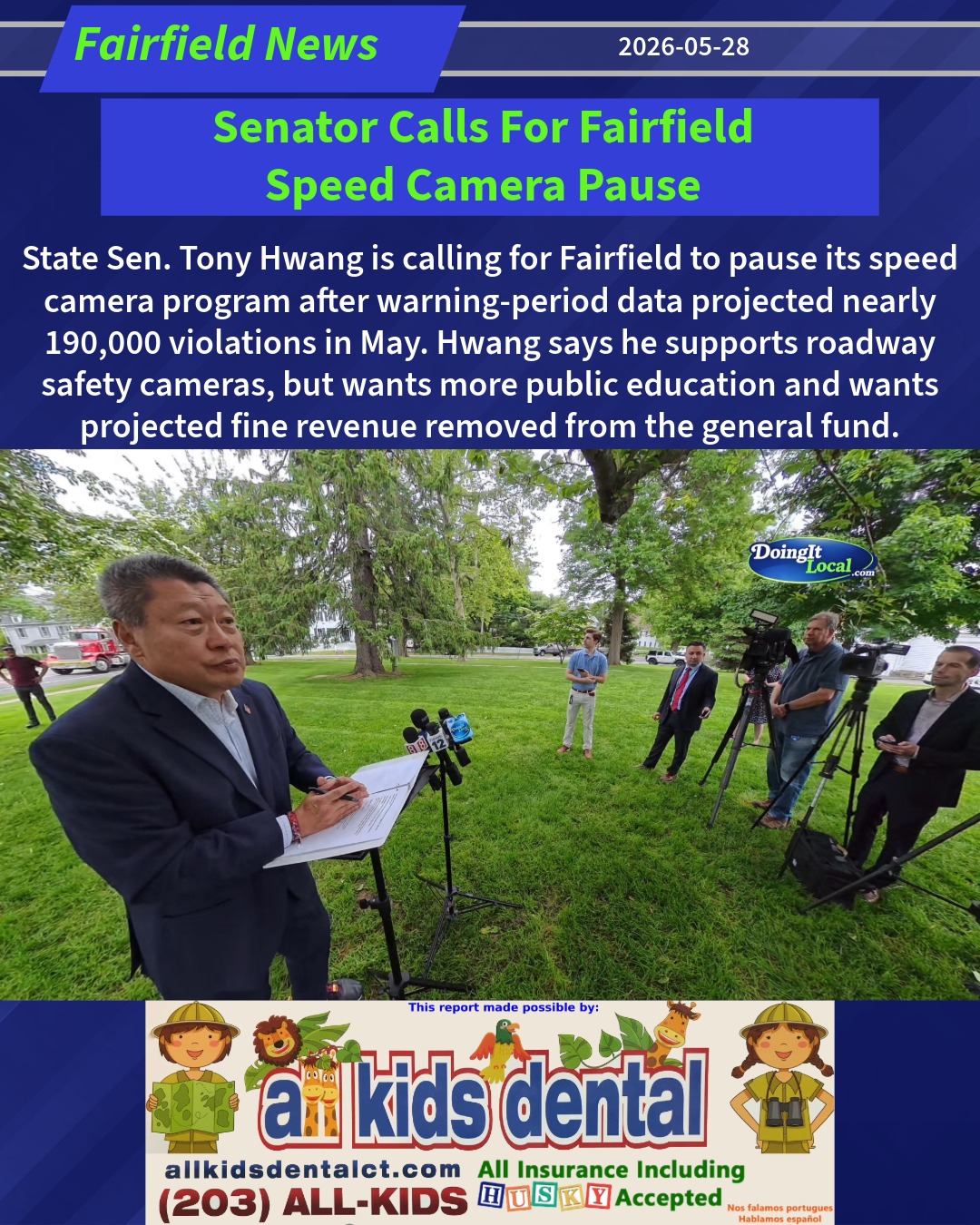
State Sen. Tony Hwang, ranking Republican leader on the Transportation Committee, is calling on Fairfield officials to pause the town’s speed camera program after warning-period data projected nearly 190,000 violations in May.
Hwang said the number is “alarming and shocking,” but not surprising, arguing that speeding has become normalized across Fairfield and other Connecticut communities. He said he continues to support speed and red-light cameras as a public safety tool, but believes Fairfield should use the May warning period to improve education, signage, public awareness and transparency before full enforcement continues.
Hwang said the program grew out of Connecticut’s 2023 Vision Zero roadway safety legislation, which allowed municipalities to adopt automated traffic enforcement programs with state approval. Connecticut’s Public Act 23-116 authorizes municipalities to use automated traffic enforcement safety devices in school zones, pedestrian safety zones and other approved locations.
Fairfield’s program began with warnings in May, and tickets are scheduled to begin in June. Recent reporting said Fairfield police projected about 190,000 violations during the warning month and roughly $3.2 million in fines during the first month of ticketing.
Hwang said the town should remove the projected fine revenue from the general fund budget and place it into a dedicated roadway safety account. He said that would help address residents’ concerns that the program is being used as a revenue source rather than as a public safety measure.
Hwang also praised Fairfield Police Chief Michael Paris and law enforcement for their focus on roadway safety, saying police have seen firsthand the serious crashes that can result from dangerous driving. Paris recently defended the program, saying the goal is to reduce crashes, slow drivers down and save lives.
Hwang said the cameras have already shown signs of changing behavior, with police data showing a drop in violations during the warning period, but he said more time is needed for public awareness to take root. He said the larger goal should be changing driver behavior throughout town, not just in the areas where cameras are located.
“This is not just about Fairfield,” Hwang said, pointing to other Connecticut communities considering or implementing similar programs. He said a pause would allow municipal leaders to listen to residents, evaluate the data, improve the rollout and protect the broader goal of roadway safety.