4th of July Stats as of Friday, July 1, 2022 12:00 a.m. to 5:00 a.m. Sunday, July 3, 2022 3,478 Calls for Service 302 Motor Assists 195 Motor Vehicle Accidents (23 with injury) 19 DUI’s (7 from motor vehicle accidents) 150 Speeding violations 15 Seatbelts 111 Hazardous Moving Violations (unsafe lane change, following too closely, etc.)
(WESTPORT, CT) – Governor Ned Lamont is reminding Connecticut residents about the state’s ParkConneCT program, which is offering increased bus services to Connecticut state parks and beaches. A continuation of a pilot program launched last year, the program offers fare-free shuttles and enhanced existing transit service to various state parks and beaches this summer through Labor Day (Monday, September 5, 2022).
The program, which is a collaboration of the Connecticut Department of Energy and Environmental Protection (DEEP) and the Connecticut Department of Transportation (CTDOT), aims to connect people to Connecticut state parks for the summer season, support seasonal employment, and promote recreational activity to improve physical and mental wellbeing.
The governor, along with CTDOT and DEEP officials, today highlighted the program by riding the Sherwood Island Shuttle from the Green’s Farms Metro North Station in Westport to Sherwood Island State Park. While at the park, the governor addressed the media and met with visitors enjoying the beach and boardwalk.
“Being able to catch a shuttle from the commuter station right to this beautiful shoreline park is a convenient resource to enjoy the outdoors that otherwise,” Governor Lamont said. “I’ve said it before and I’ll say it again, Connecticut’s state parks are one of the best things about living here, and connecting our residents to them is important. That’s what the ParkConneCT program is all about.”
“ParkConneCT increases access to the positive physical and mental benefits one can get from being out in our beautiful state parks,” DEEP Commissioner Katie Dykes said. “It can also help people who have seasonal employment with DEEP get to their workplace. Thank you, Governor Lamont and our DOT partners for the vision and collaboration on this important program. We hope you consider utilizing this service this summer and have a safe, fun, rejuvenating time in your state parks.”
“I’m excited to kick off the Fourth of July weekend by taking public transportation to one of our beautiful state parks,” CTDOT Commissioner Joseph Giulietti said. “Now is a great time to give public transit a try. It’s a convenient and reliable way to move across Connecticut. With fare free buses running statewide and through expanded free ParkConneCT services, like microtransit, trolleys, and shuttles, we’re expanding access to beaches and parks across Connecticut.”
All buses associated with the ParkConneCT pilot program will run fare free through Labor Day (September 5, 2022). Additionally, as part of the fiscal year 2023 budget, all buses statewide are operating without collecting fares until November 30, 2022 (with the exception of premium on-demand ridesharing programs). Wheels 2U and Valley Transit District’s on-demand ridesharing services will only be free on Saturdays, Sundays, and holidays observed on July 4 and September 5, when using the service to or from parks in the ParkConneCT program.
The parks included in the ParkConneCT pilot program are:
Fort Trumbull State ParkHammonasset Beach State ParkIndian Well State ParkOsbornedale State ParkSherwood Island State ParkSilver Sands State ParkSleeping Giant State Park The state parks for this pilot program were selected based on criteria prioritizing seasonal employment levels, recreational summer activities, frequently traveled tourist destinations, and existing service connections. Routes were selected by performing an analysis using geospatial information systems and prioritizing areas where the most cost-effective improvements could be made to connect people to the parks.
Since the launch of the pilot program, CTDOT has continued to collect and assess ridership and passenger trip data to measure the success of the program. Those efforts will continue this year and will include a survey to collect additional information from riders.
For more information on ParkConneCT, visit portal.ct.gov/DEEP/State-Parks/Park-Connect.
(Hartford, CT) — Attorney General William Tong joined a bipartisan coalition of attorneys general urging Congress to protect children from cannabis copycat products. These unregulated, illegal products are designed to look like popular snack items and are contributing to increased accidental THC consumption in children.
On June 16, the FDA warned that between January 1, 2021 and May 31, 2022, National Poison Control Centers received 10,448 single substance exposure cases involving edible products containing THC. Of these cases, 77 percent involved patients 19 years of age or younger. The Connecticut Poison Control Center has reported 189 cases of marijuana edible ingestion in children under age 19 since 2020. Of those, 150 were sent to the emergency department, and 66 were ultimately admitted to the hospital.
Widely available, easily mistaken for name brand snacks such as Oreo cookies, Doritos chips, Cheetos, NERDs, and more, cannabis copycat products often are unintentionally given to children or mistaken by children for the brand name snack products, resulting in unsuspecting children ingesting large amounts of THC.
“These lookalike products are unregulated and unlawful and may contain highly concentrated doses of THC. While responsible adults may be able to check serving sizes and consume these products without harm, a child who accidentally eats the whole package could become very sick. Connecticut has legalized adult-use cannabis, but many of these products fall well outside the range of what will ever be safe or authorized for sale here. Sellers may be subject to civil action under Connecticut’s consumer protection laws, but Congress needs to step in and help stop the spread of these copycats nationwide,” said Attorney General Tong.
Under Connecticut law, cannabis products may not be sold under a brand name that is identical or similar to the name of an existing non-cannabis product. Moreover, when retail establishments are licensed to sell cannabis, edible products will be subject to strict safety controls. For example, a single adult serving size of an edible cannabis product under our statute contains five milligrams of THC, and a multiple-serving package of an edible cannabis product shall contain no more than one hundred milligrams of total THC. Some of the cannabis lookalike products currently for sale contain five to six times that limit. Sellers may be subject to legal action and substantial civil penalties under the Connecticut Unfair Trade Practices Act.
The attorneys general say that while they do not all agree on the best regulatory scheme for cannabis and THC generally, they all agree on one thing: copycat THC edibles pose a grave risk to the health, safety, and welfare of our children.
Congress should immediately enact legislation authorizing trademark holders of well-known and trusted consumer packaged goods to hold accountable those malicious actors who are marketing illicit copycat THC edibles to children.
(HARTFORD, CT) – Governor Ned Lamont announced that he has signed a declaration that will enable crucial federal support Connecticut has been receiving throughout the COVID-19 pandemic – including supplemental food benefits for households in need and non-congregate housing for individuals experiencing homelessness – to continue through December 28, 2022, or until the federal public health emergency ends, whichever is earlier.
The governor specifically stated in the declaration that he does not intend to issue any executive orders under this declaration but rather wants to ensure that his administration has the authorities necessary to apply for and receive federal assistance in response to the pandemic.
“We cannot ignore the reality that the COVID-19 pandemic has disproportionately impacted low-income families and communities, many of whom continue to depend on public assistance programs administered by the state,” Governor Lamont said. “The continuation of this declaration ensures that Connecticut residents who need additional support during this time will still have access to those resources.”
Having this declaration in place throughout the pandemic has enabled Connecticut households that are enrolled in the Supplemental Nutrition Assistance Program (SNAP) to access supplemental, emergency benefits to purchase food. On average, these supplemental benefits have been providing households an additional $154.74 in food benefits per month, with all enrolled households receiving at least an additional $95.00 per month. Connecticut has received and distributed $748 million in emergency SNAP benefits since these additional allotments were first provided by the USDA Food and Nutrition Service at the onset of the pandemic.
The declaration has also enabled the state to place 6,090 individuals experiencing homelessness and several hundred survivors of domestic violence into non-congregate housing during the pandemic. Non-congregate housing is a location where each individual or household has living space that offers some level of privacy such as hotels, motels, or dormitories. Between March 2022 and May 2022, approximately 1,183 individuals experiencing homelessness were placed in non-congregate housing. Since the pandemic began, Connecticut has received $7.7 million in federal reimbursements for this non-congregate housing assistance and is expecting an additional $20.2 million in pending reimbursements.
(HARTFORD, CT) – Governor Ned Lamont is reminding Connecticut residents that the state’s minimum wage will increase from the current rate of $13.00 per hour to $14.00 per hour beginning on Friday, July 1, 2022.
The change is the result of legislation he signed into law three years ago that schedules several increases in the minimum wage over a five-year period.
“For too long, while the nation’s economy grew, the income of the lowest earning workers has stayed flat, making already existing pay disparities even worse and preventing hardworking families from obtaining financial security,” Governor Lamont said. “This is a fair, gradual increase for workers who will invest the money right back into our economy and continue supporting local businesses in their communities.”
“Governor Lamont and I are committed to making sure that our Connecticut economy works for everyone, and that includes our state’s low-income earners,” Lt. Governor Susan Bysiewicz said. “That’s why we voted three years ago to increase our state’s minimum wage at a steady rate, providing more financial security to families and providing residents the ability to continue supporting our local economy.”
Signed into law by Governor Lamont in 2019, Public Act 19-4 requires the minimum wage to increase five times over a five-year period, from the then-rate of $10.10 per hour to:
$11.00 on October 1, 2019;
$12.00 on September 1, 2020;
$13.00 on August 1, 2021;
$14.00 on July 1, 2022; and
$15.00 on June 1, 2023.
Ultimately, beginning on January 1, 2024, that same law requires the minimum wage to become indexed to the employment cost index, which is calculated by the U.S. Department of Labor, and for the first time in Connecticut the rate will grow according to economic indicators.
The state is now receiving applications for families seeking the Child Tax Rebate, one of several tax cuts approved by Democrats in this year’s state budget. Any Connecticut resident who claimed at least one dependent child under the age of 18 on their 2021 federal income tax return may be eligible for the maximum state tax rebate of up to $250 per child.
The following income guidelines will determine eligibility for the maximum rebate of $250 per child, while those with higher income rates may be eligible for a reduced rebate:Single or married, filing separately: $100,000 or lessHead of household: $160,000 or lessMarried, filing jointly: $200,000 or lessApplications will remain open until the end of July, with qualified recipients beginning to receive funds in late August. To apply, please visit https://portal.ct.gov/DRS and click the icon that says “2022 CT Child Tax Rebate.” This press release was made possible by:
Branford, CT– Bob Stefanowski, candidate for Governor of Connecticut, reacts to today’s announcement on the 9.1 cent increase on the Motor Vehicle Fuels Tax Rate on Diesel Fuel:
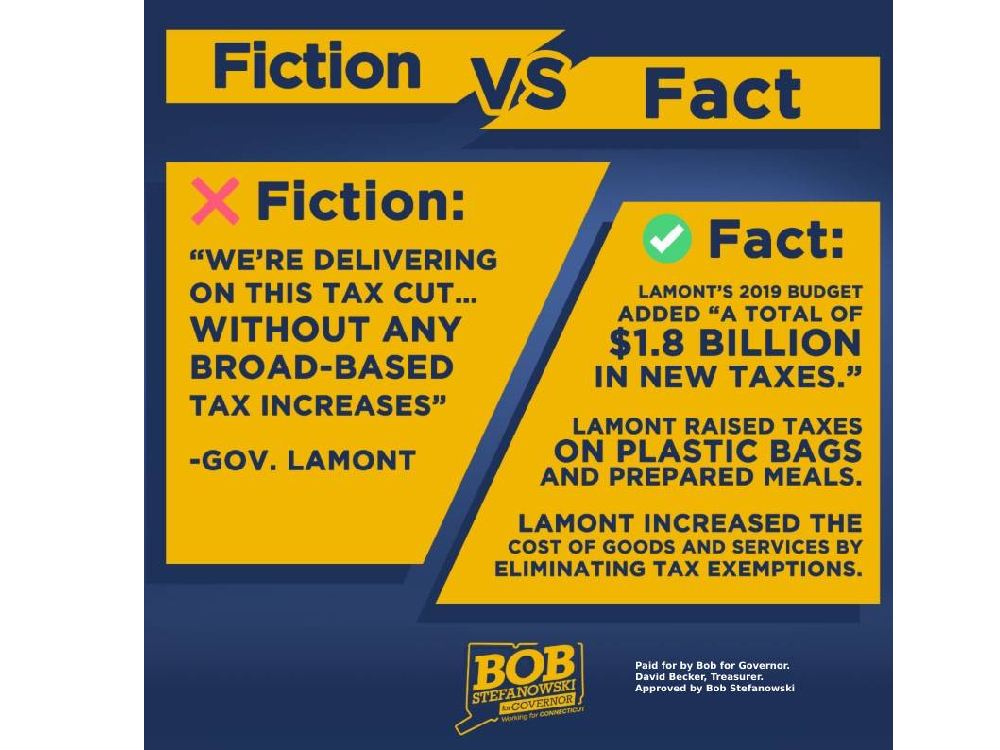
“Governor Lamont says he is a tax cutter. Really? He raised taxes by $1.8 billion his first year in office, tried his best to put up tolls, settled for the truck tax, and today, with inflation at its highest level in 40 years, raised the diesel tax by over 20%. Higher costs for goods means higher inflation, and an even more expensive state. I urge Governor Lamont to suspend all state taxes on gas and diesel to help residents get through the current crisis that he and President Biden have created.”
[WASHINGTON, D.C.] – U.S. Senators Richard Blumenthal (D-CT) and Edward J. Markey (D-MA), members of the Senate Commerce, Science, and Transportation Committee, issued the following joint statement after the National Highway Traffic Safety Administration (NHTSA) upgraded its investigation into Tesla’s Autopilot system from a preliminary evaluation to an engineering analysis after identifying additional crashes at first responder sites:
“We are encouraged that NHTSA has escalated its probe into Tesla’s Autopilot after discovering even more crashes that point to a disturbing, deadly pattern. The agency must swiftly complete this important investigation to determine if a recall is necessary while taking all steps in its power to prevent any more lives from being lost. NHTSA’s findings will be essential to improving the safety of automated driving and advanced driver assistance systems for the sake of public safety. Every day that Tesla disregards safety rules and misleads the public about its Autopilot system, our roads become more dangerous.”
Senators Markey and Blumenthal have been raising concerns about the safety issues created by autonomous vehicle (AV) technology for years. In April 2021, Blumenthal and Markey sent a letter to NHTSA and the National Transportation Safety Board (NTSB), calling for federal investigators to conduct an in-depth probe into a deadly Texas crash, and to develop recommendations for how automated driving and driving assistance systems like Tesla’s Autopilot can be improved. The full text of the letter can be found here. Amid a series of Tesla crashes in August 2021, Senators Markey and Blumenthal voiced serious concerns about Tesla’s misleading advertising and marketing of its Autopilot and Full-Self Driving (FSD) features to consumers, and called on the Federal Trade Commission (FTC) to launch an investigation and take enforcement action. In May 2018, the Senators queried major automakers and technology companies developing AVs on public roads about safety protocols for test-driving their vehicles.